
Introduction
Enterprise organizations increasingly operate databases and applications across multiple environments. Critical business data may be distributed between on-premises Oracle databases, cloud databases, analytics platforms and third-party applications.
Maintaining accurate and consistent information across these environments is a major challenge.
Oracle GoldenGate has traditionally been used for real-time data replication, high availability, disaster recovery and heterogeneous database integration.
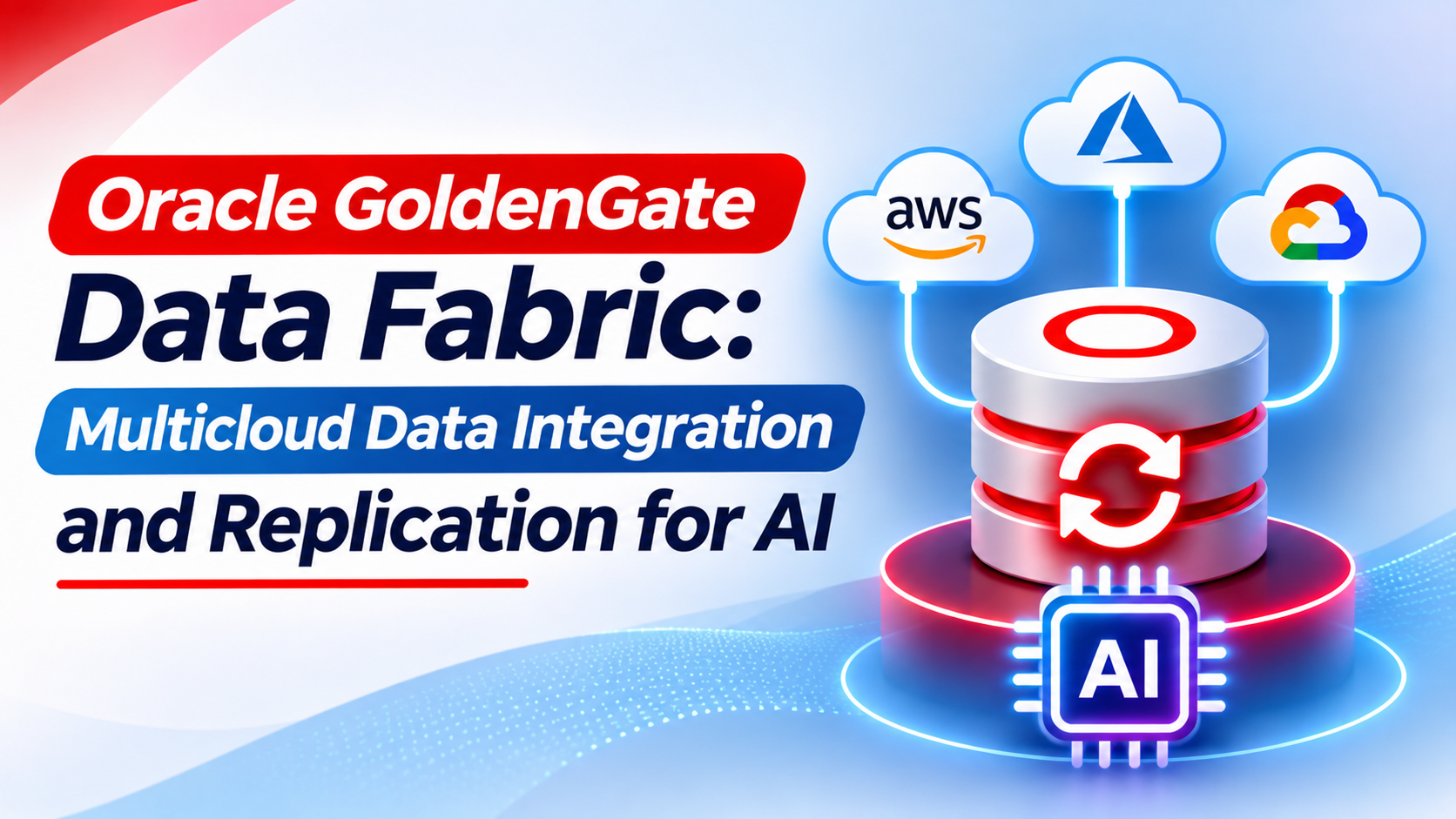
At Oracle AI World, Oracle introduced GoldenGate Data Fabric as an extension of its data integration strategy, positioning GoldenGate as a distributed data foundation for AI.
1. What Is Oracle GoldenGate Data Fabric?
Oracle GoldenGate Data Fabric is designed to connect operational systems, analytical platforms, applications and AI agents through a distributed data integration architecture.
The objective is to make trusted and up-to-date enterprise information available across different systems.
Instead of treating databases, analytics platforms and AI applications as isolated environments, the data fabric approach connects them through integrated data services.
The presentation highlighted support for:
- Oracle Cloud Infrastructure.
- Microsoft Azure.
- Google Cloud.
- On-premises environments.
- Heterogeneous data platforms.
AWS support was described as planned for a future release at the time of the presentation.
2. Why Does AI Need a Distributed Data Foundation?
AI applications require accurate, current and reliable information.
Consider an organization operating multiple systems:
- An Oracle Database supporting financial transactions.
- A MySQL database supporting an application.
- An analytics platform supporting reporting.
- A cloud data lake storing historical information.
- AI agents accessing enterprise information.
If these systems contain inconsistent or outdated data, AI-generated responses may be inaccurate.
GoldenGate Data Fabric aims to address this challenge by connecting enterprise data environments and supporting transactionally consistent data movement.
3. Role of GoldenGate Replication
Oracle GoldenGate uses log-based change data capture to identify database changes and replicate them to target environments.
In a typical replication architecture:
- Extract captures database changes.
- Trail files store captured transaction information.
- Distribution services transfer trail data.
- Replicat applies changes to the target database.
This architecture allows organizations to replicate changes without relying exclusively on periodic full data transfers.
GoldenGate supports various replication architectures, including unidirectional, bidirectional and heterogeneous replication scenarios, subject to platform and configuration support.
These capabilities provide an established foundation for distributed data integration.
4. GoldenGate Data Fabric Management
One of the announcements highlighted a graphical interface for creating and managing data fabric environments.
The presentation described three ways of working with the data fabric:
- Natural-language interaction.
- Graphical drag-and-drop configuration.
- Domain-specific language-based scripting.
The objective is to simplify the creation, monitoring and management of data integration environments.
This is particularly useful for organizations managing multiple data sources and complex replication topologies.
5. Multicloud Data Integration
Multicloud architecture is becoming increasingly common.
Organizations may operate Oracle databases on OCI while maintaining other applications and data services on Azure, Google Cloud or AWS.
GoldenGate Data Fabric aims to provide a common approach for connecting these distributed environments.
Potential use cases include:
Operational-to-analytical integration: Replicate operational database changes into analytical systems.
Cross-cloud data synchronization: Maintain data availability across supported cloud environments.
AI data integration: Provide AI applications with access to current enterprise information.
Application integration: Connect databases supporting different enterprise applications.
6. GoldenGate Data Fabric and High Availability
GoldenGate has long been used in architectures requiring continuous data movement and operational continuity.
Its replication capabilities can support architectures such as:
- Active-passive database environments.
- Active-active replication.
- Cross-region data integration.
- Database migration.
- Heterogeneous data replication.
However, GoldenGate Data Fabric should not be considered a direct replacement for Oracle Data Guard.
Data Guard is specifically designed for Oracle Database disaster recovery and high availability using physical or logical standby technologies.
GoldenGate supports a broader range of data integration and replication scenarios.
The appropriate technology depends on the required recovery objectives, database platforms and application architecture.
7. What Should Oracle DBAs Learn?
For database professionals, the announcement reinforces the importance of understanding:
- GoldenGate Microservices Architecture.
- Extract and Replicat processes.
- Trail file management.
- Checkpoint and recovery management.
- Replication latency monitoring.
- Transaction consistency.
- Multicloud database connectivity.
- Heterogeneous replication.
- Data integration security.
DBAs should also understand how replicated operational data can support analytics and AI applications.
8. Availability
During the Oracle AI World presentation, GoldenGate Data Fabric was described as being available in preview through the Oracle GoldenGate Service on OCI, Azure and Google Cloud.
AWS availability was described as forthcoming.
Organizations interested in implementing the technology should confirm the latest regional availability, supported configurations and licensing requirements with Oracle.
Conclusion
Oracle GoldenGate Data Fabric demonstrates how traditional database replication technologies are evolving to support distributed enterprise data and AI workloads.
By connecting operational databases, analytical platforms and AI applications, Oracle aims to provide a foundation for delivering accurate and consistent information across enterprise environments.
DBA Insight: GoldenGate knowledge is becoming increasingly valuable beyond traditional database replication. Understanding how to build and operate distributed data architectures will be an important skill for the next generation of database engineers.