
Introduction
Modern enterprises manage data across multiple platforms, including relational databases, cloud object storage, data warehouses and distributed data lakes.
Moving all enterprise data into a single database is not always practical. Organizations increasingly require architectures that allow them to access and analyze distributed data without unnecessary data movement.
Oracle’s Autonomous AI Lakehouse aims to address this requirement by combining autonomous database capabilities with lakehouse architecture and AI-driven data access.
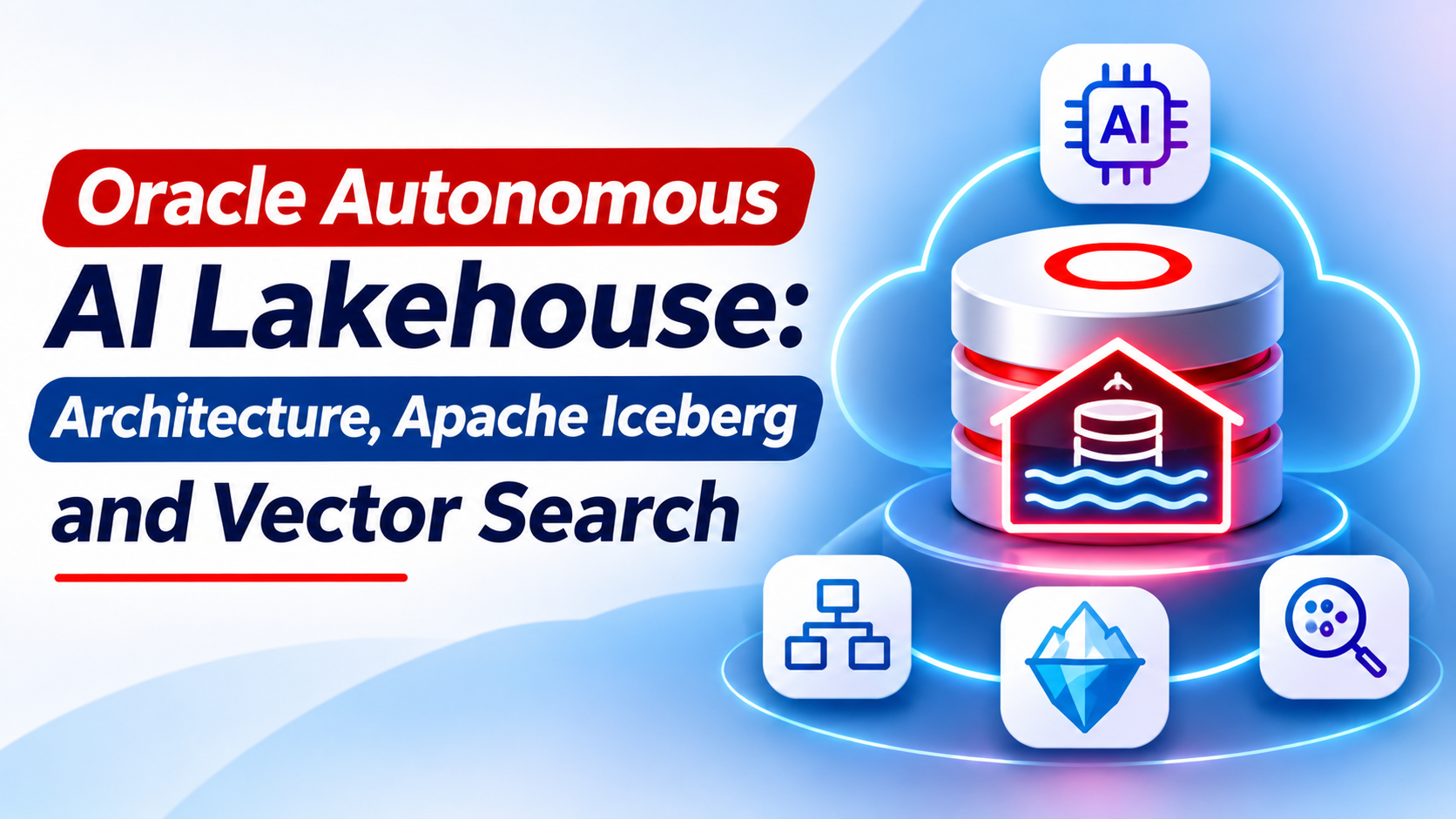
At Oracle AI World, Oracle announced several enhancements to its Autonomous AI Lakehouse offering, focusing on business semantics, data catalog integration, Apache Iceberg and query performance.
1. What Is Oracle Autonomous AI Lakehouse?
Oracle Autonomous AI Lakehouse is an offering built on the Autonomous AI Database platform.
It is designed to support analytical workloads and AI-driven data access across enterprise data environments.
The solution combines:
- Autonomous database capabilities.
- Data lake integration.
- Business semantic understanding.
- AI-powered data discovery.
- Apache Iceberg support.
- Vector search capabilities.
- Query performance optimization.
The objective is to make enterprise data more accessible to analytics applications and AI agents.
2. Business Semantic Layer
One of the important announcements was the introduction of an improved business semantic layer.
Traditional databases understand tables, columns, relationships and data types. However, AI agents also need to understand the business meaning of the data.
For example, consider a sales database containing:
- CUSTOMER_ID
- ORDER_ID
- ORDER_AMOUNT
- ORDER_DATE
- REGION_ID
A business user might ask:
“Which region generated the highest revenue last quarter?”
An AI system must understand what revenue means, which transactions should be included and how regional information is related to sales records.
Oracle’s business semantic layer aims to provide this additional context using annotations and improved analytic views.
The presentation also discussed AI-assisted annotation generation, with human review before annotations are made available.
3. AI Data Catalog
Enterprise data is frequently distributed across different platforms.
Organizations may use:
- Oracle Autonomous Database.
- Google Cloud data services.
- Snowflake.
- Databricks.
- Cloud object storage.
Oracle introduced an AI Data Catalog approach designed to bring metadata from different catalog systems into a centralized discovery and governance experience.
An important objective is to access distributed data without requiring all datasets to be physically moved into Oracle Database.
This supports data architectures where information remains in its existing storage location.
4. Apache Iceberg Integration
Apache Iceberg is an open table format designed for large analytical datasets.
It provides capabilities for managing tables in data lake environments, particularly when data is stored in cloud object storage.
Oracle highlighted expanded Apache Iceberg support as part of its Autonomous AI Lakehouse strategy.
This enables organizations to work with Iceberg datasets alongside other enterprise data sources.
For database architects, this is particularly relevant when designing hybrid analytical environments where relational databases and data lakes coexist.
5. Vectors on Ice
Oracle also highlighted the ability to work with vector data in conjunction with Apache Iceberg.
Vector embeddings represent information as numerical arrays and are commonly used in semantic search and retrieval-augmented generation (RAG).
Consider an enterprise with thousands of PDF documents containing technical manuals, policies and operational procedures.
A vector-based search system can identify documents based on semantic similarity rather than relying exclusively on exact keyword matching.
Oracle’s presentation described storing vectors in Iceberg tables or vectorizing Iceberg data with vectors stored in Oracle AI Database.
This approach can support AI applications that need to retrieve information from large distributed datasets.
6. Performance Improvements
Oracle announced two performance-related capabilities.
Data Lake Accelerator
The Data Lake Accelerator is designed to improve query performance when accessing data lake files, including Apache Iceberg datasets.
Oracle presented benchmark results showing improvements of up to 3x.
Actual performance depends on workload characteristics, dataset size and query patterns.
Lake Cache
Lake Cache is designed to improve data access performance and requires Exadata infrastructure.
Oracle presented benchmark results showing improvements of approximately 8x.
These figures should be treated as benchmark results rather than guaranteed improvements for every production environment.
7. Essbase and Business Simulation
Oracle also highlighted integration with Essbase for business simulation and what-if analysis.
This allows organizations to evaluate different business scenarios and compare possible outcomes.
Natural-language interaction makes it easier for business users to explore scenarios without requiring extensive technical knowledge.
8. Benefits for Database and Data Platform Engineers
The Autonomous AI Lakehouse introduces several architectural considerations:
- Managing structured and unstructured enterprise data.
- Integrating relational databases with data lakes.
- Understanding Apache Iceberg architecture.
- Managing vector embeddings and AI search.
- Optimizing distributed query execution.
- Maintaining data governance across multiple repositories.
- Designing analytical systems without unnecessary data movement.
Conclusion
Oracle Autonomous AI Lakehouse represents an evolution of traditional database analytics toward distributed, AI-enabled data architectures.
Its combination of business semantics, AI Data Catalog, Apache Iceberg, vector search and performance acceleration provides organizations with additional options for developing enterprise AI applications.
DBA Insight: Database professionals should expand their knowledge beyond traditional relational database administration and understand data lake architecture, Apache Iceberg, vector search and AI-driven analytics.