
Introduction
Artificial Intelligence is transforming how organizations interact with enterprise databases. Generative AI, large language models (LLMs) and autonomous AI agents can now retrieve information, generate SQL statements and support complex business decisions.
However, introducing AI into enterprise database environments creates important challenges. Organizations must ensure that AI agents cannot bypass existing security policies, expose confidential information or generate incorrect business results.
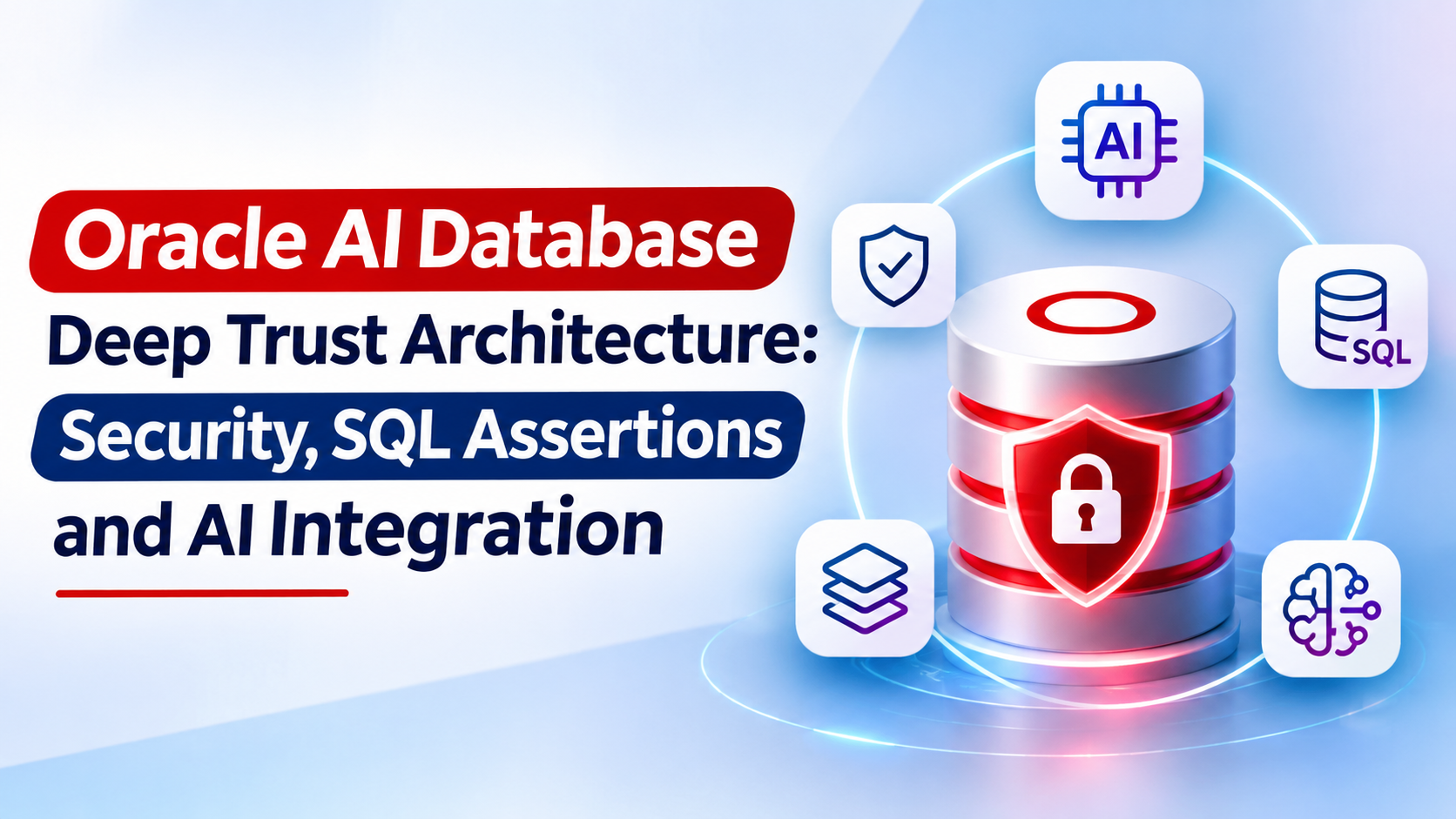
At Oracle AI World, Oracle introduced its Deep Trust AI Architecture for Oracle AI Database. This architecture combines multiple database security, data governance and application development capabilities to help organizations deploy AI solutions with greater confidence.
Rather than being a single database feature, Deep Trust AI is a combination of technologies organized into four layers.
1. Understanding the Four Layers
Oracle’s Deep Trust AI Architecture consists of four integrated layers:
- Platform
- Data
- Data Access
- Application Development
Each layer addresses a different aspect of enterprise AI security and reliability.
2. Platform Layer: Autonomous AI Database
The platform layer provides the foundation for secure database operations.
Oracle Autonomous AI Database provides managed database capabilities, including automated patching, upgrades, encryption and infrastructure management.
The presentation highlighted deployment flexibility across Oracle Cloud Infrastructure and supported multicloud environments, including Microsoft Azure, Google Cloud and AWS.
The objective is to reduce operational complexity while maintaining database availability, security and performance.
3. Data Layer: Deep Data Security
Protecting enterprise data is one of the most important requirements when introducing AI agents.
Oracle introduced Deep Data Security to strengthen how identity and access policies are enforced throughout database transactions.
The approach tracks the identity of the user or AI agent accessing the database and applies security controls at different levels.
These include:
- Row-level security.
- Column-level security.
- Fine-grained data-value protection.
- Identity propagation from applications and AI agents to the database.
This is important because an AI agent should not automatically receive unrestricted access simply because it operates through an authorized application.
SQL Assertions
Another important announcement is SQL Assertions.
SQL Assertions allow database administrators and developers to enforce complex business rules across multiple tables.
For example, an organization might need to ensure that:
- An account cannot exceed an approved credit limit.
- A business transaction must satisfy specific validation rules.
- Related records must maintain predefined business conditions.
Instead of relying exclusively on application-level validation, SQL Assertions allow rules to be enforced within the database.
This helps maintain data integrity regardless of whether information is accessed through traditional applications, APIs or AI agents.
4. Data Access Layer: Controlled AI Database Access
Giving AI agents unrestricted SQL access to production databases introduces unnecessary security risks.
Oracle addresses this through Deep Trust Data APIs, using JSON Relational Duality capabilities to expose controlled business objects.
This approach allows applications and AI agents to interact with approved business data through defined interfaces instead of requiring unrestricted database access.
Deep NL2SQL Agent
Oracle also announced Deep Natural Language to SQL capabilities as part of its AI Database Private Agent Factory.
This allows users to ask questions using natural language and generate corresponding SQL statements.
For example:
Business question:
“Show me the top five customers based on their total transaction value.”
The AI system interprets the request and generates an SQL statement using the available business context.
The presentation also highlighted feedback mechanisms that help improve the quality of generated SQL over time.
For DBAs, this introduces new opportunities for natural-language database querying while making SQL validation, authorization and execution controls increasingly important.
5. Application Development Layer: Oracle APEX AI Application Generator
The application development layer focuses on building applications using natural language.
Oracle APEX AI Application Generator allows users to describe an application requirement and generate an application blueprint using APEX Lang.
The important concept is that generated application logic can be reviewed and modified before execution.
This provides an additional layer of human oversight compared with generating large amounts of application code without sufficient review.
Since Oracle APEX operates within the Oracle Database ecosystem, applications can benefit from database security, scalability and availability capabilities.
6. Why This Architecture Matters for Oracle DBAs
The introduction of AI agents changes traditional database security and administration requirements.
DBAs will increasingly need to consider:
- How AI identities are authenticated and propagated.
- Whether AI-generated SQL follows existing security policies.
- How sensitive information is protected.
- Whether business rules are enforced at database level.
- How applications and AI agents access production data.
- How AI-generated database operations are audited.
Database security must evolve beyond protecting usernames and passwords. Organizations must also control what AI agents can access and what operations they can perform.
Conclusion
Oracle’s Deep Trust AI Architecture represents an important step toward integrating artificial intelligence into enterprise database environments.
By combining Autonomous AI Database, Deep Data Security, SQL Assertions, controlled data APIs and AI-assisted application development, Oracle is building a foundation for more secure and governed AI deployments.
For Oracle DBAs and database architects, understanding these capabilities will become increasingly important as organizations move from AI experimentation to production deployments.
DBA Insight: AI adoption should not weaken existing database security. The database must remain the enforcement point for identity, authorization, data integrity and auditing.