

If you’ve worked with MySQL for any length of time, you already know the usual story: it’s great at handling transactions, but the moment someone asks for “real-time analytics,” you’re suddenly building an ETL pipeline into a separate warehouse. Oracle’s answer to that headache is MySQL HeatWave — and it’s worth understanding what it actually does differently, not just what the marketing slides claim.
What HeatWave Actually Is
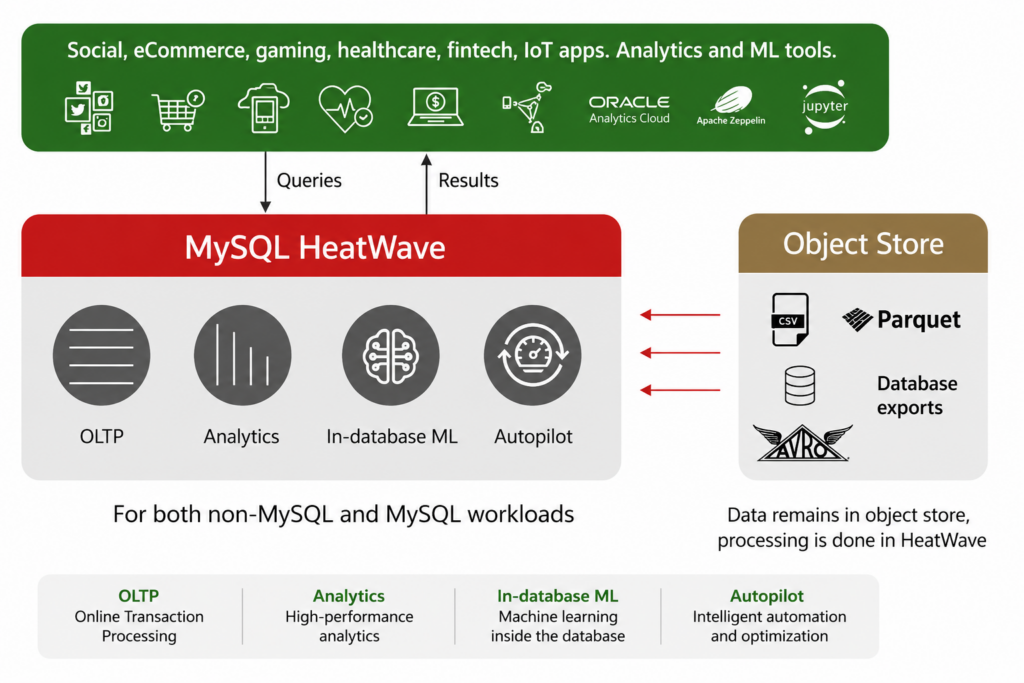
At its core, HeatWave is a massively parallel, in-memory query accelerator bolted onto MySQL and run as a managed service on Oracle Cloud Infrastructure. The interesting part isn’t that it’s “fast” — plenty of things are fast. It’s that it lets transactional and analytical workloads hit the same dataset, in the same database, without a copy step in between.


That sounds like a small thing until you’ve lived through the alternative. No nightly batch job that fails at 2am. No analytics team complaining that their dashboard is six hours stale. No second security model to maintain because your data now lives in two places instead of one.
Practically, this buys you:
- Analytics that reflect what’s happening in the OLTP system right now, not last night
- One less platform to patch, monitor, and secure
- A smaller attack surface, since there’s no data duplicated across systems
- Lower total cost of ownership, simply because you’re not paying for and operating two stacks
Why the Old Way Breaks Down
Most shops still run MySQL for OLTP and ship data elsewhere for analysis. It works, until it doesn’t.
The ETL pipeline itself is the first problem — extracting, transforming, and loading data takes time and engineering effort that could be spent on something else. Then there’s staleness: by the time your data lands in the warehouse, it’s already a snapshot of the past, which is a problem if your business actually needs to react to what’s happening right now. Add to that the security exposure of moving data between systems (more pipes, more places for something to go wrong), and the simple cost of running multiple platforms instead of one, and the math starts looking pretty unfavorable.
HeatWave’s pitch is that none of this is necessary if the analytical engine just lives next to the transactional one.
Real-Time Analytics, No ETL Required
Here’s the mechanism: when a transaction commits in MySQL, the change gets replicated into the HeatWave cluster almost immediately. Your analytical queries are then running against current data, not a copy from last week.
For something like a fraud detection system at a bank, or inventory analytics for an e-commerce platform during a flash sale, that gap between “the transaction happened” and “the system knows about it” actually matters. HeatWave is built to close that gap without the usual machinery — no duplicated data, no pipeline to babysit, no sync delays to explain to the business team.
Lakehouse: Querying Data You Never Loaded
Most organizations have far more data sitting in object storage than they have in their actual databases — some estimates put it above 80% of enterprise data living outside traditional database systems entirely. Historically, querying that meant standing up a separate data lake platform.
MySQL HeatWave Lakehouse skips that step. It lets you run SQL directly against files sitting in object storage — CSV, Parquet, Aurora exports, Redshift exports, whatever you’ve got — without ever loading them into MySQL. Scale-wise, you’re looking at up to 500TB of data and clusters that can grow to 512 nodes, which is enough headroom for most enterprise use cases.
What this actually gives you is the ability to write one SQL query that spans your transactional tables, your lake data, and combinations of both. No separate query language, no separate platform to learn.
Machine Learning Without Leaving the Database
Anyone who’s run an ML project knows the dirty secret: most of the time isn’t spent training models, it’s spent wrangling data and fighting infrastructure to get it somewhere a model can actually use it.
HeatWave AutoML tries to remove that friction by putting the whole ML lifecycle — building, training, deploying, explaining — inside the database itself.
A few things stand out here. First, the automation: algorithm selection, feature selection, hyperparameter tuning, intelligent sampling, all handled automatically, which cuts down the iteration time considerably. Second, explainability — and this matters more than it sounds, because in regulated industries like banking, you can’t just hand over a black-box prediction and call it done. Auditors want to know why the model said what it said. Third, it’s all driven through SQL, so your existing DBAs and data engineers don’t need to pick up Python or a separate ML stack just to get value out of it. And if your team prefers working in Jupyter or Zeppelin, HeatWave AutoML plugs into those too.
AutoPilot: Tuning the Database So You Don’t Have To
Database tuning has always been one of those skills that takes years to actually get good at. MySQL AutoPilot is Oracle’s attempt to automate a meaningful chunk of that expertise away.
It handles provisioning by predicting how many HeatWave nodes a given workload actually needs, rather than making you guess and over-provision. It watches resource usage over time and recommends shape changes to keep cost and performance in balance. It figures out the most efficient way to lay data out in memory. It learns from query history to keep improving execution plans rather than staying static. It manages thread pooling under heavy OLTP load. And when something does go wrong operationally, it tries to detect and recover from it automatically rather than paging someone at 3am.
None of this replaces a good DBA’s judgment entirely, but it does take a lot of the repetitive tuning work off your plate.
Security That Doesn’t Feel Bolted On
Security in HeatWave isn’t an add-on feature — it’s built on OCI’s Generation 2 architecture, which was designed with isolation and security as first principles rather than an afterthought.
A few specifics worth knowing: encryption is applied both at rest and in transit by default. Unlike a lot of competing managed MySQL offerings that run on Community Edition, HeatWave runs on MySQL Enterprise Edition, which opens the door to enterprise security features you won’t find in the free version. It’s also built to help with compliance frameworks like GDPR, PCI DSS, and HIPAA — which matters a great deal if you’re working in banking or telecom, as I imagine plenty of readers here are. And because Oracle owns the MySQL engineering team, security fixes come directly from the people who wrote the code, rather than being delayed through a third-party vendor relationship.
Fully Managed, But Not Hands-Off
Oracle handles the operational grind: patching, OS updates, backups, recovery, monitoring, log management, security updates. If you’ve spent years doing this manually, you know exactly how much time that frees up.
That said, “fully managed” doesn’t mean you lose control. Schema design, query optimization, data governance, retention policy, application architecture — all of that stays in your hands. HeatWave automates the plumbing, not the architecture decisions.
Where This Actually Fits
What makes HeatWave interesting isn’t any single feature — it’s that it collapses several products you’d normally need to buy, integrate, and maintain separately into one platform. Transactions, analytics, ML, and lakehouse querying, all on the same data, with automated tuning and enterprise security baked in.
For teams running financial platforms, IoT pipelines, or any application where the gap between “data exists” and “data is useful” needs to be as small as possible, that consolidation isn’t just convenient — it changes what’s actually feasible to build without a much bigger team.
Final Thoughts
The direction database technology is heading in is pretty clear: fewer separate systems, more automation, and analytics that don’t require waiting. MySQL HeatWave is one of the more complete attempts at that so far — folding transactional processing, real-time analytics, embedded ML, and lakehouse capability into a single managed service, without forcing you to stitch it together yourself.
If you’re currently running MySQL for transactions and bolting on a separate analytics or ML stack, it’s worth at least evaluating whether HeatWave could replace that whole pipeline rather than just adding another tool to it.