

There’s a particular kind of quiet confidence that comes from running a database platform you actually trust. Not the kind that comes from vendor slides or benchmark PDFs — the kind that comes from watching a system hold steady during a peak load event at 2 AM while the rest of the room holds their breath.
That’s what Exadata is, at its core. A platform built for the moments where failure isn’t an option.


I’ve spent over a decade working with Oracle environments across banking, telecom, and government — sectors where the database isn’t just infrastructure, it’s the business. And in those environments, the difference between a platform that performs and one that merely survives becomes very obvious, very fast.
The Problem Nobody Talks About Honestly
Here’s the thing about modern enterprise workloads: they don’t wait for you to be ready. Transaction volumes keep climbing. Someone in the analytics team decides to run a heavy query against production data. A new AI feature gets pushed without a proper capacity assessment. And somewhere in the middle of all that, you’ve got a patching window that can’t slip because the auditors are watching.
Standard database infrastructure handles most of this fine — until it doesn’t. The failure modes aren’t always dramatic. Sometimes it’s query response times creeping up. Sometimes it’s a cluster wait event that shouldn’t be there. Sometimes it’s a maintenance window that technically worked but caused enough service disruption that the business starts asking uncomfortable questions about the platform choice.
Exadata was engineered specifically to close those gaps. Not by adding features to a general-purpose server, but by rethinking the architecture from the storage layer up.
What Smart Storage Actually Changes
Most DBAs understand storage offloading conceptually. Push processing closer to the data, reduce network traffic, improve throughput. The principle makes sense.
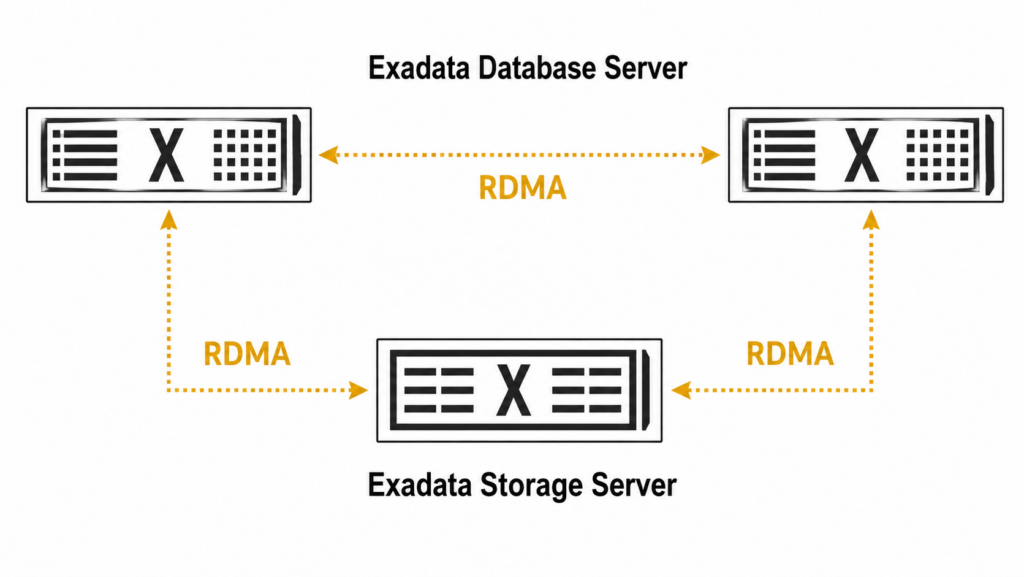
What Exadata’s storage servers actually do goes considerably beyond the concept. Smart Scan doesn’t just move some processing — it fundamentally changes how SQL executes for large analytical queries. Combined with Storage Indexes that eliminate irrelevant disk reads before they happen, and Hybrid Columnar Compression that changes the economics of storing analytical data entirely, the cumulative effect is something you notice in user behavior before you notice it in metrics. People stop complaining that reports take too long. That’s usually the real benchmark.
Flash Cache and Persistent Memory round out the storage layer by handling the latency-sensitive OLTP traffic that Smart Scan wasn’t designed for. The platform isn’t choosing between OLTP and analytics — it’s handling both simultaneously, at the storage level, without compromising either.
RAC on Exadata: This Is What Active-Active Is Supposed to Mean
Active-active clustering is one of those terms that’s been stretched beyond recognition. I’ve seen environments described as active-active where the second node was essentially waiting politely to be needed. That’s not what Oracle RAC on Exadata delivers.
Every node is processing real workload. Every node is a valid connection target. When one fails — hardware fault, kernel panic, whatever the cause — sessions reconnect and work continues. There’s no manual handoff, no runbook to execute at midnight. The cluster handles it.
The scale-out story is equally practical. Adding nodes extends capacity without touching application configuration. Workloads redistribute. Users continue working. For teams managing growing Oracle estates, the ability to add capacity without a change freeze and a weekend maintenance window is genuinely useful — not just in theory, but in the operational calendar.
Smart Connection Rebalancing: The Problem It Actually Solves
Cross-instance cache traffic is one of those RAC challenges that shows up quietly and gets expensive quickly. When sessions with similar data access patterns land on different nodes, the cluster spends significant resources moving cached blocks between instances. The result is elevated cluster wait times and degraded throughput — and traditionally, addressing it required either careful application-level workload routing or significant DBA attention.
Smart Connection Rebalancing in Oracle RAC 26ai handles this automatically. The system detects which workloads belong together, groups them, and routes new connections accordingly — improving cache locality without any application changes or manual tuning. Oracle’s reported 95% reduction in cluster wait events for eligible workloads is the kind of number that sounds like marketing until you see it reflected in AWR data.
The sequence performance improvements in 26ai deserve equal attention. High-volume OLTP applications that rely on ordered sequences have historically hit throughput ceilings in RAC environments due to sequence cache contention across nodes. The 26ai improvements — up to 40% better throughput for single-node access, approximately 2x across all RAC nodes — directly address a real-world pain point that DBAs in those environments know well.
Patching Without the Sunday Night Anxiety
Honest question: how much of your operational stress comes from patching? Not the patch itself, but the window negotiation, the rollback planning, the post-patch verification, the business stakeholders who’ve been told “minimal impact” one too many times and are now skeptical by default.
Two-Stage Rolling Updates change the patching calculus meaningfully. Applying the patch and activating the fix are decoupled — you can distribute across nodes during a low-traffic window and activate later, in a controlled manner. More patches become effectively rolling updates. The maintenance window gets shorter. The risk profile improves.
Local Rolling Maintenance takes a different approach to the same problem. A new instance starts on the same physical server, sessions migrate automatically, and patching happens on the vacated instance while users stay connected. Network traffic during maintenance drops. CPU consumption during the process is reduced. For environments with genuinely narrow change windows — banks with core processing schedules, telcos with traffic patterns that never really go quiet — this kind of granularity matters.
Self-Healing Infrastructure: What It Looks Like in Practice
The Database Reliability Framework isn’t a feature you configure. It runs continuously, watching cluster activity, adjusting memory allocation, detecting contention before it surfaces as user-visible latency. The practical outcome is a system that tends to degrade gracefully under pressure rather than suddenly.
Enhanced hang detection in Oracle RAC is similarly understated in most product documentation. Cross-instance hangs — the kind where one node is waiting on another and the cascade starts building — resolve faster through automated detection and recovery. Application-induced hangs that would previously have required DBA investigation now get caught and resolved before they become incidents. That’s a meaningful shift in operational posture for teams managing large RAC clusters.
On the AI Capabilities — Practically Speaking
“AI-ready” shows up in a lot of infrastructure marketing right now, so it’s worth being specific about what Exadata actually offers here rather than repeating platform talking points.
Oracle’s AI vector capabilities allow relational data, JSON, graph, spatial, and vector data to live together in a single database environment. RAC can allocate specific instances to handle vector search and Retrieval-Augmented Generation workloads while other instances continue serving transactional traffic unaffected. For enterprises building AI applications on top of existing Oracle data estates, this matters — because the alternative often involves copying data out to a separate vector store, which introduces latency, synchronization complexity, and additional infrastructure to manage.
Consolidating on Exadata doesn’t eliminate those architectural choices, but it expands what’s possible without adding platforms.
The Environments That Benefit Most
Exadata performs across a wide range of workloads, but it earns its cost most clearly in specific contexts: financial systems where transaction throughput and sub-millisecond response are both mandatory, healthcare and government platforms where data volumes are large and availability requirements are strict, and mixed-workload environments where the alternative is running separate infrastructure for OLTP and analytics.
The consolidation argument is real. Managing one engineered platform rather than multiple specialized servers reduces the operational surface area meaningfully. Fewer systems to patch, fewer failure domains to monitor, fewer specialists required to maintain distinct infrastructure stacks.
Closing Thought
Exadata has been around long enough to outlive several rounds of “the market has moved past this” commentary. The reason it keeps showing up in mission-critical environments isn’t loyalty or inertia — it’s that the platform consistently delivers under conditions where other options have visible limitations.
If you’re running workloads where performance and availability are genuinely non-negotiable, Exadata is worth evaluating seriously. Not because the marketing materials say so, but because the production track record across industries tends to back it up.
And in this business, track record is the only benchmark that actually counts.