

Let me be direct about something most patching guides won’t say out loud: the hardest part of applying an Oracle patch is rarely the patch itself.
It’s the phone call to the business asking for a maintenance window.
I’ve had that conversation more times than I’d like to count — sitting in a change advisory board meeting, explaining why a critical security fix needs four hours of downtime on a Sunday at 2 AM, watching the room fill with uncomfortable silence from people who don’t quite understand why a database can’t just… update itself quietly. Oracle RAC was supposed to solve this with rolling patching. And it did, partially. But there was always a category of patches that broke the deal — fixes where Oracle needed every node running identical code before it could safely activate the change. Those patches meant downtime. Full stop.
Oracle AI Database 26ai’s Two-Stage Rolling Updates changes the rules on that. Here’s what it actually does and why it matters.
The Problem With “Rolling” Patching That Was Never Quite Rolling Enough
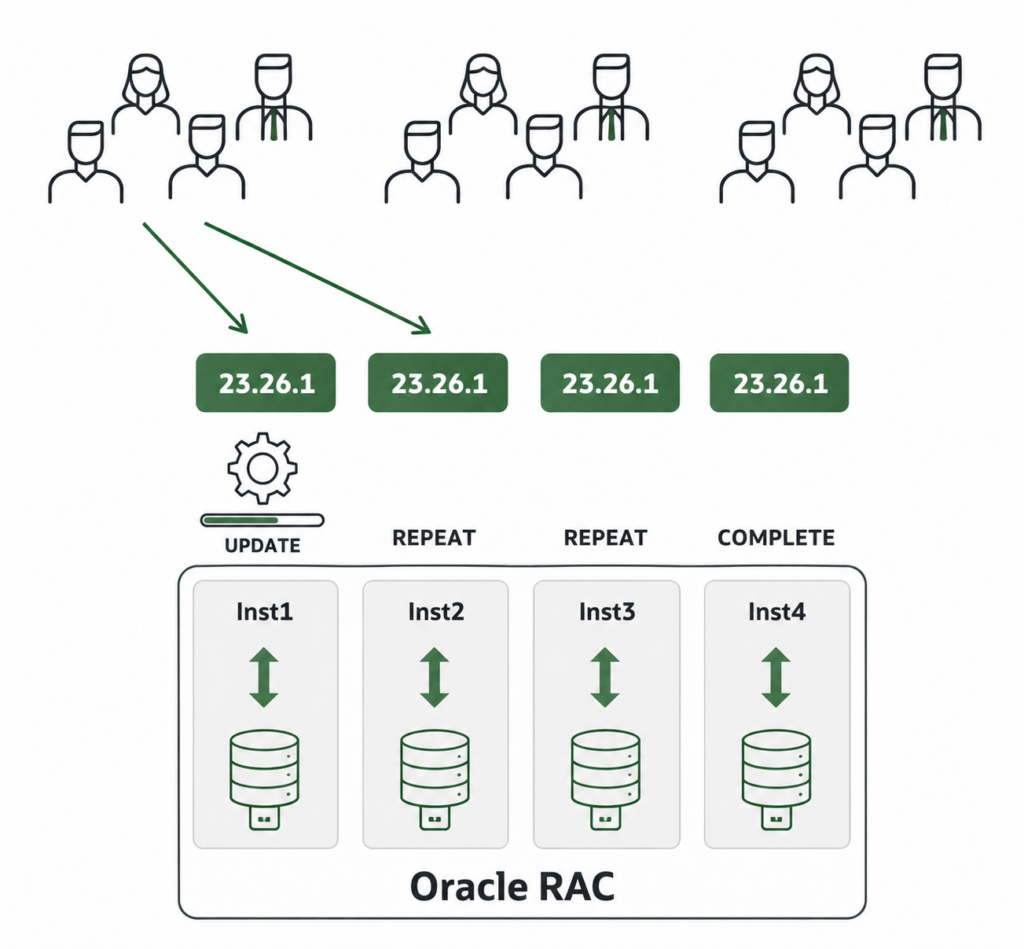
Oracle RAC’s rolling patch capability is genuinely useful. You patch one node, fail services over, patch the next, repeat. Applications keep running. Users don’t notice. Life is good.
Except when it isn’t.
Certain bug fixes — particularly those that modify how instances coordinate with each other, manage undo, or handle lock messaging — can’t safely coexist in a mixed-version cluster state. If Node 1 has the fix active and Node 3 doesn’t, you can end up with behavioral inconsistencies that are worse than the original bug. Oracle’s solution, historically, was to classify those patches as non-rolling: everyone goes down, everyone gets updated, everyone comes back up together.
For a banking system processing ATM transactions around the clock, or a telco billing platform that runs 24/7, that classification was the difference between a routine Tuesday afternoon and a major incident process, customer notifications, and a lot of very unhappy stakeholders.
What Two-Stage Rolling Updates Actually Changes
The insight behind this feature is elegantly simple: the problem isn’t installing the patch across mixed-version nodes — it’s activating it prematurely.
So Oracle 26ai separates those two things.
Phase 1 — Deployment: You patch each RAC node one at a time, in rolling fashion, exactly as you would with any rolling patch. The binaries go on. The fix is there. But it stays dormant. Cluster compatibility is maintained throughout. Applications keep running. From the outside, nothing has changed.
Phase 2 — Activation: Once every node in the cluster has received the patch, you flip a single switch to enable the fix cluster-wide simultaneously. At that point, all instances are already running the updated software, so there’s no mixed-version problem. No downtime. No maintenance window. Just a SQL command:
sql
ALTER SYSTEM ENABLE RAC TWO_STAGE ROLLING UPDATES ALL;That’s it. What used to require a planned outage now requires a SQL statement.
The elegance here is that Oracle isn’t doing anything fundamentally complex — they’re just giving the activation step its own moment, separate from the installation step. But the operational impact of that separation is significant.
What This Means for Real Enterprise Workloads
I want to ground this in something concrete, because the abstract benefits are easy to dismiss as marketing language.
Think about a core banking environment running Oracle RAC across four nodes. Quarterly Release Updates come out on schedule. The security team wants them applied within 30 days. But the business impact team won’t approve a maintenance window on any day ending in ‘y’ because something is always happening — quarter-end, a product launch, a regulatory deadline, a public holiday in one jurisdiction or another.
The practical result is that patches get delayed. Sometimes for months. Security fixes that should be in production within weeks are sitting in a staging environment because no one can agree on when to take the downtime. That’s not a hypothetical — it’s a pattern I’ve observed repeatedly in financial services environments, and it introduces real risk.
Two-Stage Rolling Updates shortens that negotiation significantly. If activation doesn’t require downtime, the change advisory conversation becomes much simpler. You’re not asking for an outage window. You’re describing background maintenance that users won’t experience. That’s a fundamentally different risk profile, and it makes faster patch adoption genuinely achievable rather than aspirational.
Important Caveats Worth Flagging Early
A few things to be clear-eyed about before you get too excited:
Not every patch qualifies. The two-stage mechanism applies to patches that Oracle has specifically designed to support deferred activation. You’ll need to check patch documentation to confirm eligibility. This isn’t a blanket “all patches are now rolling” announcement — it’s an architectural capability that broadens the set of patches that can be applied without downtime.
The staging step still matters. Installing binaries across a production RAC cluster while services are running is still a meaningful change activity. Test in non-production first. Verify cluster health — CRS, ASM, interconnect, service registrations — before you start. Keep your rollback procedures current.
Timing the activation step matters. The activation command should still be coordinated, even though it doesn’t require downtime. Pick a lower-traffic period if you can, monitor closely immediately after, and have your DBA team available. It’s not a crisis if something unexpected happens, but you want eyes on it.
How This Fits Into Oracle 26ai’s Broader HA Story
Two-Stage Rolling Updates doesn’t exist in isolation. Oracle 26ai introduced a suite of RAC enhancements that collectively push the platform toward what you’d call genuinely continuous operations — the kind of availability that was previously aspirational for maintenance activities:
- Smart Connection Rebalancing reduces cluster contention by routing sessions to where their data already lives
- Local Rolling Maintenance extends rolling capabilities to a wider set of administrative operations
- Database Reliability Framework improvements tighten fault detection and recovery coordination
- Faster hang detection reduces the time between a problem occurring and the cluster responding to it
Two-Stage Rolling Updates is the patching piece of that story. It’s less glamorous than AI vector search or near-linear RAC scaling benchmarks, and it probably won’t get featured in keynote slides. But for the enterprise DBA who manages a production Oracle RAC environment and has to answer for uptime, it’s arguably the most immediately useful thing in this release.
Patches that previously required downtime to apply will now qualify for rolling deployment. Security fixes will get into production faster. Maintenance windows will shrink. Those outcomes compound over time in ways that genuinely improve the operational posture of the environments that depend on them.