

Let me be straight with you — most organizations don’t need a Data Lake. They think they do, because someone in a strategy meeting used the term, or a vendor pitched it beautifully with a slide full of arrows and cylinders. But the truth is, a Data Lake is only as useful as the team and the intention behind it.
That said, when the conditions are right, it’s one of the more powerful things you can build in a modern data environment. I’ve seen it done well. I’ve seen it done badly. The difference is almost never technology.
So What Is It, Really?
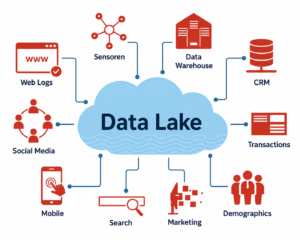
Think of a Data Lake as a storage system that doesn’t ask questions. You throw data at it — structured tables, JSON blobs, video files, log dumps, sensor streams — and it takes everything. No rejections, no reformatting required before entry.
That’s the core difference from a warehouse. A warehouse wants clean, dressed data. Everything gets modeled and scrubbed before it walks through the door. Useful, yes. But slow — and it quietly discards context you didn’t know you’d want later.
The lake’s approach? Take it all in now. Decide what matters when you actually need it.
That’s a calculated trade-off. You’re betting that future flexibility is worth more than upfront structure. For the right use cases, that bet pays off.
The Data Problem Nobody Talks About Honestly
Think about everything your organization produces in a single day. Emails, call recordings, scanned forms, support tickets, application logs. Nearly all of it — some estimates put it around 95% — doesn’t fit neatly into rows and columns.
Most of that data never gets analyzed. It lands in a file server somewhere, ages out of a retention policy, and gets deleted — having contributed nothing.
The organizations building real machine learning capabilities are the ones figuring out how to actually use that material. You can’t train a useful fraud detection model on clean transactional records alone. You need volume, variety, and the messy reality of how your business actually operates day to day.
That’s the gap a Data Lake is designed to fill.
What It Actually Does Well
A few things stand out.
It onboards new data sources fast. No schema negotiations, no ETL pipeline redesign, no three-month modeling project. A new API feed can be flowing into the lake the same week.
SQL teams, ML engineers, streaming pipelines — they can all pull from the same underlying storage without collision. Assuming the architecture isn’t a mess, which requires actual upfront thought.
It scales without drama. Cloud object storage is genuinely elastic. You pay for what you use, add capacity without downtime, and don’t have to predict three years of growth in advance.
Put purchase history next to support tickets next to clickstream data, and you start seeing things no individual system ever showed you. That’s not a sales pitch — it’s just what happens when context stops being siloed.
Data Lake vs. Data Warehouse — The Version Nobody Simplifies Enough
People overcomplicate this comparison. I’ll keep this tight.
| Data Lake | Data Warehouse | |
|---|---|---|
| What goes in | Raw, unprocessed, any format | Cleaned, structured, modeled |
| Schema | Defined when you read the data | Defined before data is stored |
| Cost | Cheaper storage | More expensive |
| Who uses it | Data engineers, scientists | Analysts, business users |
| Best for | Exploration, ML, large-scale analytics | Reliable reporting, dashboards |
They’re not competitors. A warehouse gives your finance team reliable Monday morning reports. The lake gives your data scientists three years of raw behavioral data to train a model. Different jobs, different tools — most mature teams end up running both.
The architecture that combines them — often called a lakehouse — is where things are heading. But you need to walk before you run.
Why Most Data Lake Projects Fail
Nobody leads with this in the vendor presentations, but Data Lake failures are common. The term “data swamp” didn’t come from nowhere.
The pattern usually looks like this. Storage gets provisioned, pipelines get pointed at it, data starts flowing in from everywhere — and six months later someone asks what’s actually in there and nobody has a clean answer. Nobody trusts it. Nobody’s using it. It’s just big.
Usually it’s not one thing. Almost always the same few issues keep showing up.
No clear use case. “Store everything and see what we learn” is not a strategy. It’s a storage bill. The projects that work start with a specific problem — cut fraud losses, reduce customer churn, optimize inventory. Everything else follows from that.
No governance. Who owns the data? What does each dataset contain? How current is it? Who’s allowed to access it? These questions need answers before data volumes make them impossible to answer retroactively.
Wrong team. A Data Lake is not something you hand to a junior DBA and check on quarterly. You need people who’ve built this before and made the mistakes already. Not someone learning on the job with production data.
Treating it like a database. It’s not one. Expecting row-level transactional performance from a lake is like blaming a cargo ship for not handling like a speedboat. Wrong vehicle for the job.
The Security Conversation People Skip
This one matters more than most implementation guides let on.
A Data Lake that accumulates years of customer records, financial transactions, health data, and behavioral profiles without proper access controls is a regulatory incident waiting to happen. It’s a large, well-organized target.
Authentication and authorization need to be in place before data flows in — not added later as a cleanup task. Encrypt everything — at rest, in transit, no exceptions. Fields containing PII, financial records, health data? Mask them. Not eventually. From day one. Every access pattern needs an audit trail.
This isn’t theoretical. Organizations have built genuinely impressive lakes and then discovered that half the company had read access to data they had no business seeing, because the default permissions were never properly locked down.
Security is architecture. It goes in at the foundation, or it costs you far more later.
Building on the Right Foundation
Cloud object storage is the obvious answer for most organizations — Oracle Object Storage, Amazon S3, Azure Blob, Google Cloud Storage. Honestly, go with whatever you’re already running. Switching cloud providers for the lake rarely makes sense unless you have a compelling reason.
The cost model alone makes cloud storage hard to argue against. No upfront hardware, no capacity planning guesswork, no weekend maintenance windows for storage expansion. Running this on-premises in 2025 is a choice, but it’s not the easy one.
The storage layer is the easy part. What sits above it — how data gets catalogued, how pipelines are managed, how transformations are versioned — that’s where teams actually struggle. And the honest reality is that vendor tooling for all of this has come a long way. A few years ago building custom made more sense. Today, the default answer should be buy-first, build only when something specific genuinely doesn’t exist.
The Four Stages That Actually Matter
Think of a Data Lake not as a destination but as a pipeline. Data moves through four stages, and each one requires real design attention.
Ingestion is where data enters. APIs, streaming platforms, batch exports, IoT devices, enterprise applications — it all comes in here, ideally with consistent metadata tagging so you can find it later. The goal is to capture data intact and in its original form. Don’t transform here. Just collect.
Storage is where raw data lives. Partitioning strategy matters enormously at this stage — how you organize data in the lake determines whether downstream queries run in seconds or hours. Getting this right early saves significant pain later.
Transformation is where raw becomes useful. Cleansing, standardization, enrichment, joins with reference data — this is where you prepare data for analytical consumption. The output typically lands in a curated layer, separate from raw storage, where it can be reliably queried.
Analysis is where the investment pays off. Dashboards, ML models, predictive pipelines, segmentation queries — all drawing from the curated layer. This is what the business actually sees. The quality of everything upstream determines how trustworthy what appears here actually is.
One thing worth remembering: this isn’t a one-way flow. Insights from the analysis stage often reshape what gets ingested in the first place. The lake evolves as you learn what actually matters.
The Bottom Line
A Data Lake done right is a genuine competitive asset. It gives you access to data you couldn’t previously use, enables analytical capabilities that fragmented systems can’t support, and creates a foundation for machine learning work that’s otherwise impossible to scale.
But it’s not a shortcut. It’s not plug-and-play. And it definitely doesn’t deliver value just by existing.
The organizations that get real returns share a few things: they started with a clear problem, brought in the right people, locked down governance from day one, and never treated the lake as the goal itself — only as a means to one.
Data volumes aren’t shrinking. If anything the pace is accelerating. The question isn’t whether you’ll need infrastructure that handles data at scale — it’s whether what you’ve built will actually be ready when that moment arrives.