

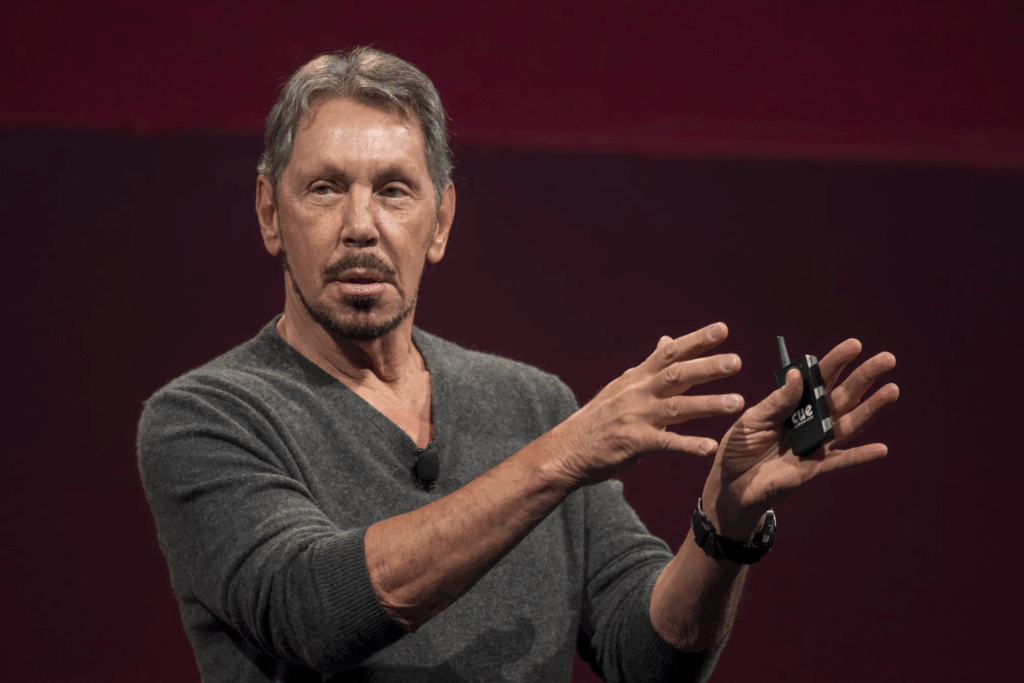
When Oracle’s founder and Chief Technology Officer Larry Ellison took the stage at Oracle AI World 2025, he began with a simple but powerful line: “AI changes everything.” It wasn’t an exaggeration. Over the next 90 minutes, Ellison laid out how Oracle is positioning itself at the center of the world’s most transformative technological shift — one that merges vast data, reasoning machines, and human creativity.
From Cloud to Cognitive Computing
Ellison reminded the audience that just a few years ago, Oracle’s flagship conference was called Cloud World. Today, “cloud” feels like yesterday’s buzzword. The new focus is AI World, a sign that computing has entered an entirely new phase.


He described the evolution of AI in two waves:
- Building the brains — massive multimodal neural networks trained on internet-scale data.
- Using the brains — deploying those models to solve problems that once felt unsolvable, from diagnosing cancer to designing better cities.
These AI models are no longer single neural nets; they are multimodal systems, much like the human brain. Some parts interpret language, others analyze images, sound, and movement. When combined, they can see, hear, and reason.
The Largest Infrastructure Project in Human History
Training AI models at this scale isn’t a software project — it’s an engineering feat. Ellison shared that Oracle is constructing one of the world’s largest AI clusters in Abilene, Texas:
- 450,000 NVIDIA GB200 GPUs
- 1.2 billion watts of power (enough to supply a million homes)
- Eight data-center buildings spanning more than a thousand acres
This infrastructure forms the digital foundation for OpenAI, Grok, Anthropic, and many others. “It’s the largest and fastest-growing business in human history,” Ellison said, comparing the AI era to the industrial revolution — only faster and far more global.
Private Data Meets Public Intelligence
One of Oracle’s key differentiators is where the world’s most valuable data already lives — inside Oracle Databases. Public data powers large language models, but private data — the kind that drives banks, hospitals, governments, and retailers — is what makes AI truly useful.
To bridge the two, Oracle has re-engineered its flagship database into what Ellison calls the Oracle AI Database. It introduces vector processing and retrieval-augmented generation (RAG), allowing AI models to reason securely on both public and private data.
In practice, this means a company can ask questions like:
“Which of our customers are most likely to buy Product X in the next six months?”
The AI agent can analyze historical data, generate personalized recommendations, and even trigger automated workflows such as sending customized follow-up messages — all without exposing private information. It’s an elegant balance between data privacy and AI intelligence.
AI Agents and the End of Traditional Coding
Another striking point in Ellison’s talk was Oracle’s embrace of AI-generated applications. Within the Oracle APEX platform, developers can now describe their intent in plain English, and the AI automatically generates the underlying application code — a process Ellison jokingly called “vibe coding.”
These AI-generated applications come with:
- Built-in security and scalability
- Stateless recovery (auto-restart in another data center if one fails)
- Zero human error in configuration or access control
Oracle itself uses AI-generated agents to automate sales forecasting, customer engagement, and even internal IT management. “We’re no longer handwriting code,” Ellison explained. “We declare intent — and the AI writes the program.”
Rebuilding Healthcare from the Ground Up
Healthcare dominated much of Ellison’s keynote. When Oracle acquired Cerner, its aim wasn’t just to modernize hospital software — it was to automate the entire healthcare ecosystem: patients, providers, regulators, insurers, and banks.
Ellison described how AI agents connect hospitals with insurers to ensure treatments are both effective and fully reimbursable. For example, in the UK, prescribing Ozempic may not be covered by the NHS, but alternative medications might. Oracle’s system reasons across medical literature, insurance policies, and patient data to recommend the best care that is also reimbursable.
He also introduced AI applications that handle cash-flow management for hospitals, automatically validating claims and helping banks lend against receivables with near-zero default risk.
Oracle’s goal isn’t limited to hospitals — it’s about creating a connected healthcare ecosystem where automation reduces paperwork and returns doctors’ focus to patients.
AI Beyond the Datacenter: Medicine, Food, and Climate
Ellison’s vision went far beyond software. He highlighted Oracle’s collaborations on AI-driven medical diagnostics capable of detecting cancer at microscopic precision and metagenomic testing devices that can identify any pathogen — even novel viruses — in minutes. Such tools could provide the early-warning system the world lacked before COVID-19.
He also outlined projects in AI-powered agriculture, such as:
- Robotic greenhouses that grow crops with 90 percent less water.
- AI-engineered wheat that produces 20 percent more yield while absorbing CO₂ and converting it into calcium carbonate — literally helping balance Earth’s atmosphere.
- Nitrogen-fixing crops that eliminate fertilizer runoff, a leading cause of river pollution.
These examples captured how Ellison sees AI not just as a business advantage but as a civilization-level tool for sustainability.
Humanizing the Machines
Despite the scale of automation, Ellison insisted AI will not replace humans — it will enhance us. “AI will make us better scientists, teachers, surgeons, and engineers,” he said. Robots will perform surgeries with microscopic precision, but human compassion and judgment will remain central.
In one vivid example, he described how future robots could learn tasks such as cooking or playing guitar simply by watching internet videos — learning in seconds what takes humans years. The key isn’t replacing people; it’s amplifying human potential.
The Rise of Oracle as the Intelligent Cloud
Oracle now positions itself uniquely among hyperscalers. While Amazon, Microsoft, and Google focus on either cloud infrastructure or consumer AI, Oracle bridges both worlds — building AI infrastructure and AI-native enterprise applications.
That dual capability lets organizations train cutting-edge models and apply them to core business systems — from financials to HR to healthcare. Oracle’s Fusion Cloud suite already integrates AI-assistants that cut hiring times, automate workflows, and guide employees through tasks.
As one customer from global engineering firm Wood PLC testified in a video segment, Oracle’s AI reduced their average time-to-hire from 45 days to 21 days — a tangible reminder that AI’s impact is measured not in hype but in human outcomes.
A Future Built on Intelligence
Ellison closed with optimism. The world ahead, he said, will be “healthier, longer-lived, and better fed.” AI will eradicate inefficiencies that humans have tolerated for centuries. From hospitals to farms, from autonomous drones detecting wildfires to systems securing identity through biometrics, the intelligent age is already here.
And through it all, Oracle is quietly rewriting its own story — from database company to architect of intelligent infrastructure.
Conclusion: The Journey Continues
Oracle’s transformation isn’t about hype; it’s about creating the tools, infrastructure, and vision to power the AI economy responsibly. The synergy between data, intelligence, and ethics will shape how industries evolve in the coming decade.
For readers eager to dive deeper into Oracle’s expanding AI ecosystem and the breakthroughs unveiled at Oracle AI World 2025, explore:
- 🔗 Oracle AI Database 26ai — The Future of AI-Driven Data
- 🔗 Inside Oracle AI World 2025: Oracle AI Database 26ai and the Rise of the AI DBA
- 🔗 MySQL AI — The Future of Intelligent Databases
Together, these updates highlight how MySQL AI, Oracle AI Database, and the broader Oracle Cloud Infrastructure are redefining the meaning of intelligent computing — and shaping a smarter, more connected future.