
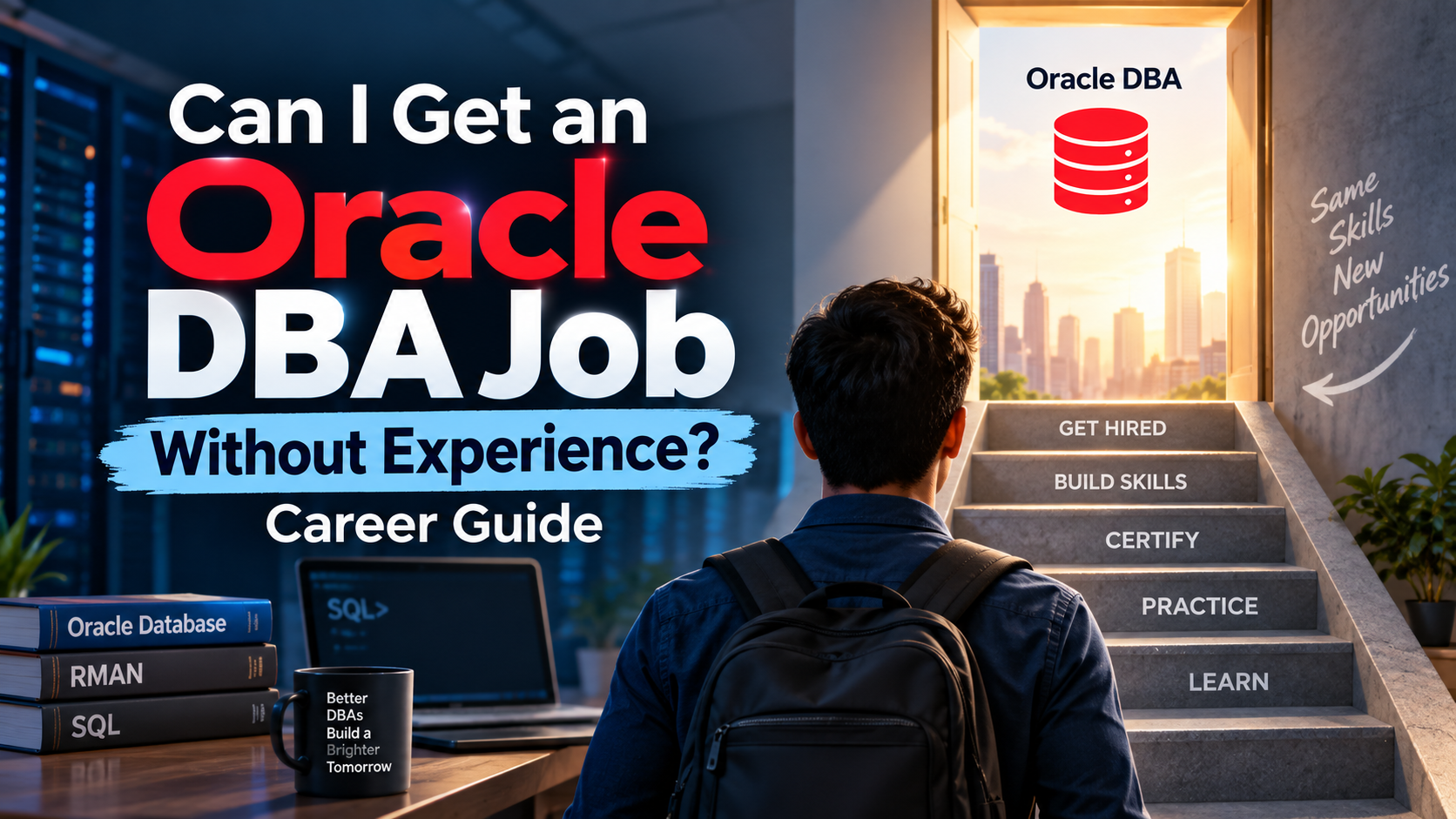
Yes. Just not as an “Oracle DBA” on your first job, and anyone who tells you otherwise is selling a course.
I get this question a lot. Usually it comes from someone who has finished a degree, or spent a few years in a support role, or watched a few YouTube videos on RMAN and now wonders if the door is open. It is open. It’s just narrower than the job ads suggest, and you have to come in sideways.
Why nobody wants to hand you the keys
Think about what a production database actually is. In banking it’s account balances. In telecom it’s billing for millions of subscribers. In government work it’s records people can’t afford to lose. Now imagine the hiring manager looking at a CV with no production time on it. They’re not asking “does this person know Oracle?” They’re asking “what happens when this person makes a mistake at 3 a.m. with nobody watching?”
That’s the real barrier. Not knowledge, trust.
So the whole game is finding ways to build trust before you have the title.
Getting in sideways
The most common route I’ve seen is production support. L1, L2, application support, whatever your company calls it. You aren’t touching the database directly, at least not at first, but you sit close enough to hear how the DBA team talks during an incident. That alone is worth a lot. Ask to shadow them. Offer to take the dull stuff, like checking whether last night’s backup jobs finished, or finding which session is blocking everyone else. Most DBA teams are stretched thin and will happily hand you small tasks if you ask nicely and don’t break anything.
SQL development is another door. I know DBAs who came over from writing reports, and they were usually good at tuning because they’d spent years being annoyed by slow queries themselves.
Then there are junior DBA or trainee posts at managed service providers and system integrators. Pay is modest. But you see many different environments quickly, which a single in-house job can’t give you. In Sri Lanka, banks’ technology arms and telecom operations teams sometimes train people from scratch if they show enough interest.
And Linux. If you’re already comfortable as a sysadmin, you have maybe a third of the job covered before you start. I’ve seen outages that had nothing to do with Oracle at all. A file system filled up, archive logs had nowhere to go, the database hung. [Swap in one of your own real incidents here.]
What to learn, roughly in order
I’d skip RAC and Data Guard at the start. Really. I’ve watched people spend months on advanced topics and then stumble when asked what a redo log is for.
Get good at SQL first. Not just SELECT statements, but joins, subqueries, indexes, and reading an execution plan without your eyes glazing over. Learn enough Linux to move around, check disk space, read logs and schedule a cron job.
Then the architecture. Instance versus database. SGA and PGA. What the background processes do. How a transaction travels from COMMIT to disk. If you can explain that to a friend over tea without notes, you know more than some people I’ve interviewed.
After that comes the actual DBA work: RMAN backup and recovery, users and privileges, tablespaces, basic tuning, patching. Recovery deserves the most practice. Taking a backup is easy. Restoring one while somebody senior is standing behind you is where people find out what they really know.
Build a lab and break it
Your lab is your experience, so treat it seriously. A laptop with 16 GB of RAM will run an Oracle Linux VM with a database inside it. Oracle has a free database edition for learning, and OCI has an Always Free tier too, though the terms change, so look at Oracle’s site before you commit to anything.
Then wreck it on purpose. Delete a datafile and get it back. Fill the archive destination and watch what happens. Do a point-in-time recovery over and over until you stop opening the docs. Every time you fix something you broke yourself, you collect a story for interviews. Stories beat bullet points on a CV, every time.
Write things down too. I started dbainsight.com mostly as a notebook for myself, and somewhere along the way it started opening doors I hadn’t expected. You don’t need readers. You need one hiring manager to stumble on a post where you explain a problem clearly.
Certifications: useful, but overrated by beginners
I’d start with an entry-level OCI certification, since cloud is where most of the work is heading, then aim for the Oracle Database Administration professional track. Oracle Learning Explorer and Oracle University have run free training and occasional free exam windows, so check before paying.
But here’s what I noticed when I helped eight colleagues get through their professional certifications: the ones who passed comfortably were the ones who had already broken things in a lab. The ones who only read the book struggled, even the smart ones. A certificate says you studied. It doesn’t say you can cope.
Two certificates plus a working lab will get you further than five certificates and nothing else.
The interview
They’ll ask scenario questions. The database is slow, where do you look first? A tablespace hits 95%, what are your options? A datafile is gone, what now?
Nobody expects a perfect answer. What they listen for is order. Check the alert log. See what’s running. Ask what changed recently. Don’t touch anything until you understand it. If you haven’t done it in production, say so: “Not in production, but in my lab I did this, and here’s how I’d approach it.” That works far better than bluffing, and experienced DBAs can spot a bluff in about two questions.
One more thing that gets underestimated. So much of the job is talking. Writing a clear handover note, explaining to a nervous manager what’s going on, staying calm while people keep messaging you. Technical skill gets you shortlisted. Calm gets you kept.
How long it takes
If you’re consistent and land a support or junior role, twelve to twenty-four months to a proper DBA position is realistic. Quicker if you already have Linux or development behind you. Slower if you’re studying at night after a full day of something else, which is how a lot of us did it.
Your first job probably won’t be glamorous. Mine wasn’t. But a year around real systems teaches you things no course can.
So start with SQL and Linux this week. And by Friday, break something in your lab.
What Is a Database Administrator (DBA)
Oracle Database Release Roadmap 2026: Current Support Status, 19c, 21c and 26ai