

Here’s a scenario every DBA has lived through at least once. A COMMIT goes out, the connection drops a split second later, and now nobody can say for sure whether that transaction actually landed. Not the app, not the developer on call at 2am, not you staring at the alert.
That’s the problem AC and TAC exist to solve. Both are Oracle’s way of letting sessions survive a failure without the application falling apart, but they go about it in pretty different ways, and mixing them up (or picking the wrong one) usually means more manual babysitting down the road than you’d like.
I want to walk through this properly, because I still get asked “aren’t these basically the same thing?” more often than I’d expect.
Why This Even Needs Solving
Take something as boring as:
UPDATE emp
SET salary = salary * 1.10
WHERE employee_name = 'Anil';

COMMIT;
Nothing fancy. Now say the redo log gets the transaction, the commit actually succeeds on the server side, and right before that success message makes it back to the app… the instance crashes. Or the network just drops. Doesn’t really matter which.
From where the application’s sitting, it has no clue what happened. Did it commit? Did it fail somewhere along the way? Should it just fire the statement again and hope for the best?
That last option is the dangerous one. Blindly replaying an unconfirmed transaction is how you end up with a salary bumped twice, an order placed twice, a transfer posted twice. I’ve personally had to help reconcile a mess like this on a banking system once, and it is not a fun afternoon.
TAF Got Us Partway There
Oracle’s first crack at this was Transparent Application Failover — TAF. It reconnects your session to a healthy RAC instance after something breaks. Fine, as far as it goes. But TAF only handles the reconnect part. It has zero visibility into whether your last statement actually committed before things went sideways.
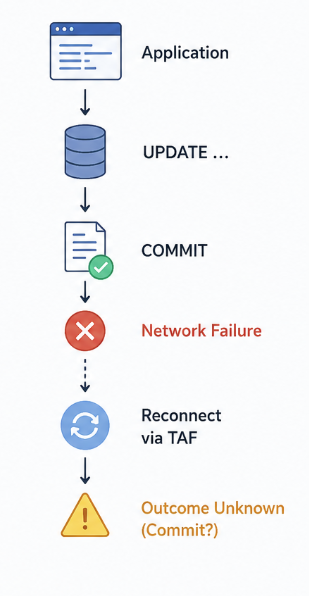
So you’re back online, sure, but you’re still stuck asking a question TAF can’t answer — did that commit go through? All you get is an error, and from there it’s on the dev team to figure out the right move by hand. Every single time it happens.
Transaction Guard Actually Answers the Question
This is where Transaction Guard comes in, and honestly it’s the piece that makes everything downstream possible. Every transaction gets tagged with a unique ID. When the session reconnects after a hiccup, Oracle checks that specific ID and tells you, definitively: did it commit or not.
So instead of a guessing game you get a flat answer — transaction 5254 committed, full stop, or it never did. That certainty is the foundation everything else in this article builds on.
AC: Reconnect, Then Pick Up Where You Left Off
Application Continuity takes that certainty and does something more ambitious with it. It doesn’t just tell you the outcome — it restores the session, restores whatever state that session had, replays the calls that got interrupted, and keeps going like nothing happened.
That’s really the whole pitch: make the outage invisible from where the user’s sitting. Ideally they never notice a thing.
TAC: Basically the Same Idea, Less Setup
TAC is the newer, lower-maintenance version of the same concept. AC often needs you to tell it what’s safe to replay and what isn’t. TAC tries to work that out on its own. For a lot of fairly standard applications it genuinely does just work out of the box, which is honestly kind of nice for once.
So Where Do They Actually Split?
Really it comes down to one question: who’s deciding what’s safe to replay, you or Oracle?
Planned maintenance, unplanned failures, RAC, Active Data Guard — both handle all of that. Both replay automatically too. Where they differ is configuration (AC leans manual, TAC leans automatic) and who owns the call on external actions — with AC that’s the administrator, with TAC Oracle just avoids replaying anything it’s unsure about. AC tends to fit complex, highly customized enterprise apps better; TAC tends to fit most everyday modern applications just fine.
This Is the Part That Actually Trips People Up
Say your app does something like this on order placement:
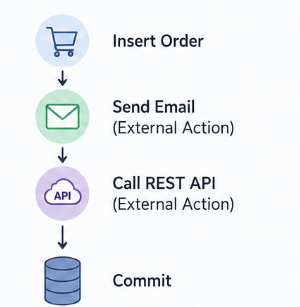
Replaying the database insert is fine, Oracle knows how to handle that safely. But the email? The REST call out to some third-party service? Those happened outside the database’s world entirely, and Oracle has genuinely no way to know if firing them again is harmless or a disaster waiting to happen.
Play it out:
Order Confirmation Email
    ↓
Failure
    ↓
Replay
    ↓
Customer gets two emails
Or worse — a payment goes out twice. Neither of those is something you can shrug off, which is exactly why this distinction isn’t just academic.
TAC’s answer is to be conservative about it. If it spots something like UTL_HTTP, UTL_SMTP, or any external REST/API call, it just won’t replay that piece automatically — it protects data consistency by stopping rather than guessing.
AC hands that decision to you instead. If you know your app well enough, you can tell Oracle explicitly to ignore certain external calls during replay — a monitoring ping, a log write, an API endpoint you know is idempotent. You’re accepting the risk on that call, but you get flexibility TAC won’t give you by default.
Basically: TAC assumes it doesn’t know your app well enough to gamble. AC assumes you do.
Picking Between Them
If you’d rather keep configuration minimal, you’re running mostly standard Oracle-supported apps, and you’re comfortable letting Oracle make the safety calls — TAC’s your default.
If your workflows are genuinely complex, you understand your own replay behavior in detail, and you need custom rules around what does and doesn’t get replayed — that’s when AC earns its place.
Oracle itself tends to point most organizations toward TAC first, mostly because it’s less to deploy, less to configure, and generally a smoother ride operationally. AC comes into play once your integrations get complicated enough that the default automatic discovery isn’t cutting it anymore.
Wrapping Up
Both AC and TAC are chasing the same outcome at the end of the day — keep database failures invisible to the end user without wrecking transaction integrity in the process. The difference is just who’s making the call on what gets replayed.
TAC leans toward caution and automation. AC leans toward flexibility and hands-on control. Neither one wins outright; it really depends on how tangled your application’s workflow actually is.
If you’re running RAC, Active Data Guard, or Oracle AI Database 26ai, it’s worth actually sitting down and figuring out which of these genuinely fits your setup — not just defaulting to whichever name you heard first. You’ll appreciate having made that call the first time a real outage hits mid-transaction on a busy system.