

In today’s data-driven world, organizations are collecting massive volumes of real-time data—from IoT sensors and financial transactions to security logs and application events. Traditional database insert methods often struggle to keep up with this scale. That’s where Fast Ingest in Oracle Database comes into play—especially with its latest enhancements.
This article explores how Fast Ingest has evolved, what limitations have been removed, and why it’s becoming a powerful feature for high-throughput systems like data warehouses and cloud-native applications.


What is Fast Ingest?
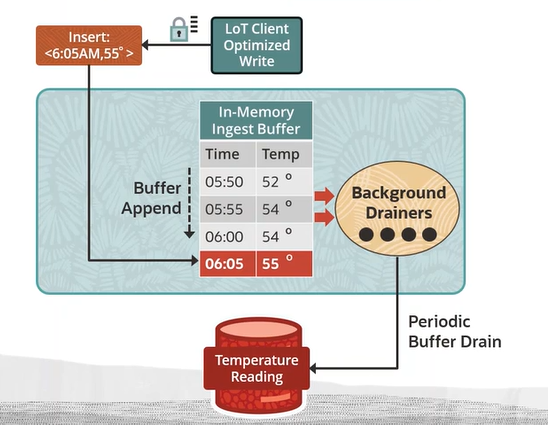
Fast Ingest, also known as deferred inserts, is a performance-focused feature designed for high-frequency data ingestion. Instead of writing data directly to the traditional buffer cache, Fast Ingest writes incoming rows into a memory area within the large pool, and then asynchronously flushes them to disk.
This approach significantly reduces contention and improves throughput, especially when dealing with streaming or bursty workloads.
As highlighted in the lesson content, Fast Ingest can handle extremely high transaction volumes—making it ideal for use cases such as IoT telemetry, where thousands (or even millions) of data points are generated per second .
Key Enhancements in Fast Ingest
Recent improvements have made Fast Ingest far more flexible and production-ready. Previously, several limitations restricted its adoption—but many of those barriers have now been removed.
1. Support for Advanced Table Features
Fast Ingest now supports:
- Common default values for columns
- Transparent Data Encryption (TDE)
- Inline LOBs
- Virtual columns
- Partitioning (including subpartitioning, interval partitioning, and auto list partitioning)
This is a major leap forward. Earlier, these features prevented the use of Fast Ingest. Now, organizations can take advantage of both advanced schema design and high-speed ingestion simultaneously.
2. Cloud Compatibility with Encryption
In modern cloud environments, encryption is often mandatory. Oracle Cloud, for example, encrypts user data by default.
Previously, this created a challenge for Fast Ingest adoption. But with support for encrypted tablespaces, Fast Ingest is now fully compatible with cloud deployments.
This means you can safely combine:
- High-speed ingestion
- Secure data storage
- Cloud-native architecture
without compromise.
3. Faster Data Flushing and Ingestion
One of the biggest performance advantages comes from bypassing the buffer cache entirely.
Instead:
- Data is written into the large pool
- Background processes handle batch flushing
- Writes are optimized and grouped
This results in:
- Faster ingest rates
- Reduced memory contention
- Improved scalability
Because flushing happens in batches, systems can achieve significantly higher throughput compared to row-by-row inserts.
Why Fast Ingest Matters for Real-Time Systems
Fast Ingest is particularly valuable in scenarios where speed is critical.
IoT and Sensor Data
Imagine temperature sensors in an industrial system. If a reading exceeds a safe threshold, action must be taken immediately.
Fast Ingest allows:
- Rapid data capture
- Near real-time analytics
- Faster anomaly detection
Security Monitoring
For systems monitoring security events:
- Delays can be costly
- Immediate insights are essential
Fast Ingest ensures that large volumes of logs are ingested quickly, enabling faster detection of threats.
How Fast Ingest Works Behind the Scenes
The architecture is simple but powerful:
- Data is inserted into a table marked with
MEMOPTIMIZE FOR WRITE - Instead of buffer cache, data goes into the large pool
- Background processes (like SMCO) flush data to disk
- Writes happen in batches for efficiency
This design avoids bottlenecks associated with:
- Buffer cache management
- Frequent disk I/O
- Lock contention
Configuration and Management
Fast Ingest is flexible and relatively easy to manage.
Key Parameters
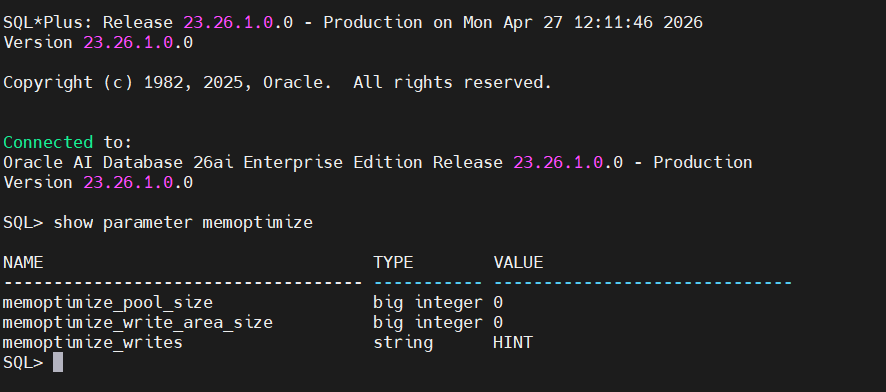
MEMOPTIMIZE_WRITE_AREA_SIZE
- Defines the size of the memory area in the large pool
- Dynamic parameter (no restart required)
- Must be consistent across RAC instances
MEMOPTIMIZE_WRITE
- Controls whether Fast Ingest is enabled
- Can be applied:
- Globally
- At session level
- Using hints
Monitoring the Write Area
Oracle provides a view to track usage of the Fast Ingest memory area.
Key metrics include:
- Total allocated memory
- Used memory
- Free space
- Number of writes
- Active writers (sessions)
- Container (PDB) usage
This visibility helps DBAs:
- Optimize memory allocation
- Avoid under/over provisioning
- Monitor workload behavior
DBMS_MEMOPTIMIZE Package
Oracle also provides a management package:
DBMS_MEMOPTIMIZE
This includes useful procedures such as:
- Retrieving low/high water marks of sequence numbers
- Checking ingest activity across sessions
- Flushing data from memory to disk
WRITE_FLUSH Procedure
This is especially important for DBAs.
It allows:
- Flushing all Fast Ingest data
- Across all sessions
Typical use cases:
- Before database shutdown
- During maintenance
- Ensuring data persistence
Important Considerations
While Fast Ingest is powerful, it comes with trade-offs:
1. Possible Data Loss
Since data is initially stored in memory:
- It is not protected by redo/undo
- A system crash may result in data loss
2. No Immediate Query Visibility
Data in the large pool:
- Cannot be queried until flushed to disk
3. Constraint Handling
Constraints and indexes:
- Are validated only during flush
- Not at insert time
Because of this:
- Disabling constraints may improve performance
- Validation should be handled carefully
Performance Benefits
Benchmarks have shown:
- Up to 75% faster ingestion compared to traditional inserts
- Ability to handle millions of inserts per second
These improvements make Fast Ingest ideal for:
- Data warehouses
- Streaming platforms
- Real-time analytics systems
Best Practices
To get the most out of Fast Ingest:
- Use it for high-frequency insert workloads
- Allocate sufficient large pool memory
- Monitor usage regularly
- Use
WRITE_FLUSHbefore shutdown - Implement validation mechanisms for critical data
Final Thoughts
Fast Ingest in Oracle Database has evolved into a robust and flexible solution for modern data challenges. With support for advanced features like encryption, partitioning, and LOBs, it is no longer limited to niche use cases.
Instead, it’s becoming a core capability for organizations dealing with:
- Real-time data streams
- Massive ingestion workloads
- Cloud-native architectures
By combining speed, scalability, and improved flexibility, Fast Ingest enables businesses to process and analyze data faster than ever before.
If you’re working in a data-heavy environment—especially with IoT, analytics, or cloud systems—this is a feature worth exploring and implementing.