

Oracle Database 23ai introduces one of its most powerful performance-boosting features yet — True Cache.
If you’ve ever wished your applications could respond faster without changing a single line of code, this is the feature you’ve been waiting for.
Let’s break it down in plain English.

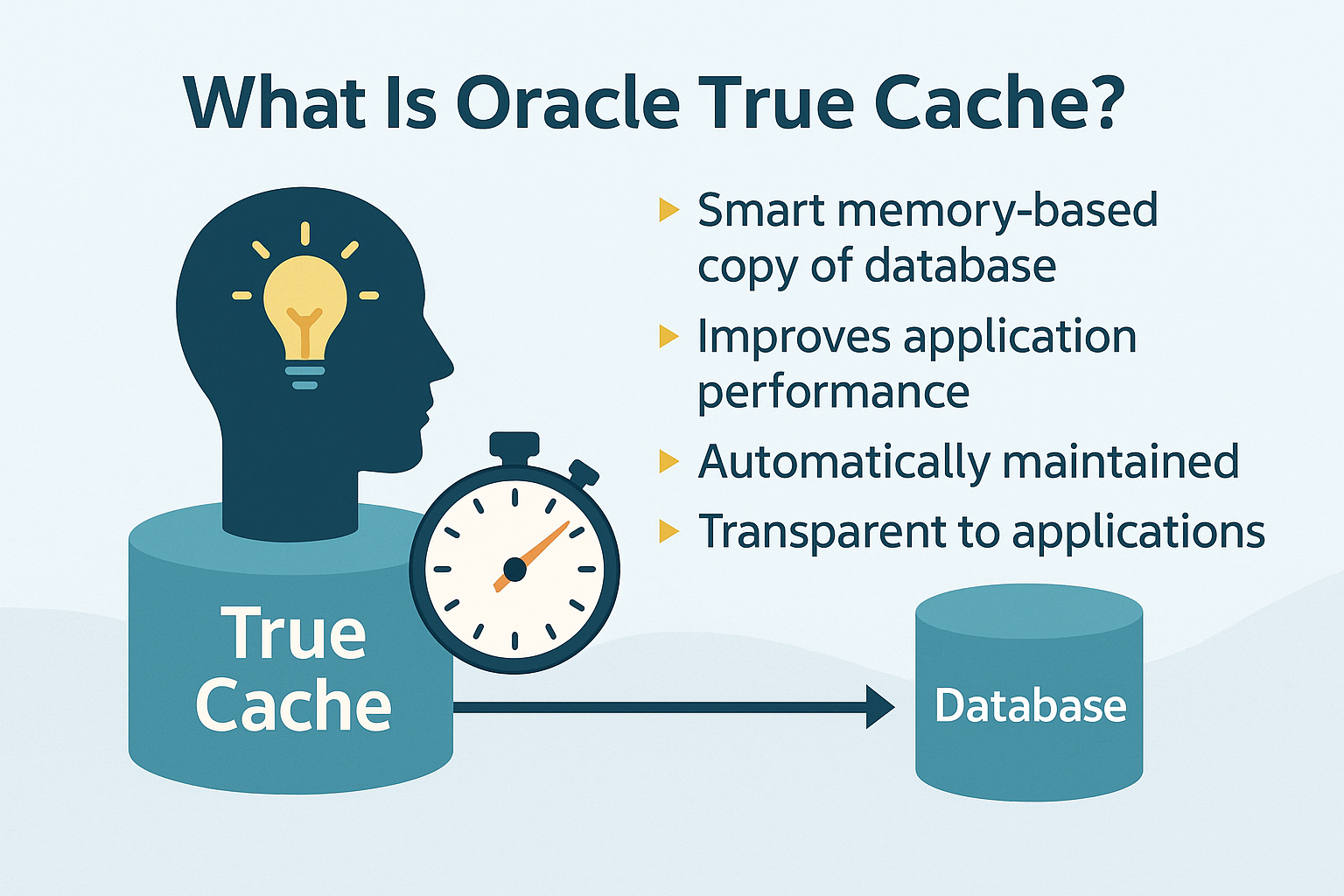
What Is Oracle True Cache?
Think of True Cache as a smart, memory-based copy of your database that sits closer to your application.
Instead of every user request going all the way to the primary database, True Cache can serve the data directly from its local in-memory copy — dramatically improving speed and reducing network traffic.
It’s automatically maintained, transparent to your applications, and requires no code changes.
Oracle takes care of keeping it synchronized with the main database, ensuring consistency and reliability.
Key Benefits of True Cache
True Cache was designed with real-world performance challenges in mind. Here are its biggest advantages:
✅ Boosts application performance – Queries are served faster from memory rather than disk.
✅ Reduces response time and network latency – Especially powerful when the database and application are in different locations.
✅ Large in-memory cache – Can hold massive amounts of frequently accessed data.
✅ No manual intervention – Oracle automatically maintains and updates the cache.
✅ Fully transparent – Works with your existing apps; no changes to SQL or middleware required.
It also leverages the full power of Oracle Database — including indexing, compression, partitioning, and advanced data types like JSON, Graph, and Spatial — unlike separate caching layers that often come with limitations.
How True Cache Works (High-Level View)
At startup, True Cache is empty. It gradually loads chunks of data from the primary database into memory.
When a query comes in:
- The application decides whether to fetch from True Cache or the primary database.
- If the data is cached, it’s instantly returned from memory.
- If not, True Cache fetches it from the primary database and adds it to its cache.
- The cache is continuously updated using redo logs — similar to Oracle Active Data Guard.

Only committed data is cached, ensuring consistency. Even if multiple True Caches are deployed, Oracle automatically balances and distributes sessions among them.
What You Need to Know Before Using True Cache
Before enabling True Cache, keep these points in mind:
- You’ll need sufficient memory to store the frequently accessed data.
- A small amount of storage is required for configuration and redo log files.
- True Cache is read-only, but you can still perform updates using DML redirection — where writes are automatically sent to the primary database.
- To enable this, set the initialization parameter
ADG_REDIRECT_DMLtoTRUE.
- To enable this, set the initialization parameter
One of the foundational features that makes True Cache possible is Active Data Guard’s DML Redirection — introduced in Oracle 19c — which enables updates to be accepted at standby databases and forwarded to the primary for execution. Learn more about how this works and why it’s a game-changer for high availability in our detailed post: Active Data Guard DML Redirection in Oracle 19c
How Applications Use True Cache
There are two ways your applications can connect to True Cache:
1. Two Physical Connections
The application maintains two connections:
- One to the primary database
- One to the True Cache
The app decides dynamically which connection to use — reading from True Cache and writing to the primary DB.
This works with any existing database drivers or languages.
2. One Logical Connection (for Java Apps)
Java applications using the JDBC Thin driver (Oracle Database 23ai and later) can maintain a single logical connection that automatically switches between True Cache and the primary database behind the scenes.
If the query is read-only, it’s routed to True Cache; if it involves updates, it goes to the primary database.
Concurrency Control in True Cache
Oracle ensures lock-free concurrency control using ETags (Entity Tags) — a mechanism familiar from web APIs.
- When an application fetches a JSON document, an ETag is created.
- When it tries to update that document, Oracle checks if the ETag still matches.
- If it does, the update proceeds; if not, it means another session changed the data, and the update is rejected and retried.
This mechanism ensures fast, safe updates even across distributed caches.
Configuring and Deploying True Cache
True Cache supports flexible deployment models depending on your workload and architecture.
1. Uniform Configuration
All True Cache instances hold the same set of data.
Applications are evenly distributed across caches using the same database application service.
Example setup:
- One primary database (e.g.,
PRIMDB1) - Two True Caches (
TCDB1,TCDB2) - Remote listener for load balancing

Oracle automatically keeps all caches in sync using redo apply from the primary database.
2. Partitioned Configuration
For large-scale systems, True Cache supports partitioning, where each cache holds a different subset of data.
This allows the total cache size to be much larger than a single database.
There are two partitioning options:
a. COLOCATION_TAG
Each True Cache handles sessions with a specific tag (e.g., US or EUROPE).
This ensures all related sessions connect to the same cache.

b. Multiple Services
Each True Cache is tied to a different database service (e.g., SALES_TC, HR_TC).
Ideal for organizations running multiple business applications on a single primary database.

When to Use True Cache
Use Oracle True Cache when:
- You need fast read performance for frequently accessed data.
- Your applications are geographically distributed.
- You want in-memory performance without sacrificing consistency or maintainability.
- You prefer an Oracle-native solution that integrates seamlessly with your existing setup.
Final Thoughts
Oracle True Cache in Oracle Database 23ai marks a huge step forward in database acceleration and application responsiveness.
It’s simple, automated, and built directly into the database engine — no external caching layers, no complex maintenance.
Whether you’re running enterprise applications, analytics, or real-time APIs, True Cache helps deliver the speed your users expect while keeping your data reliable and consistent.
Want to explore more about Oracle Database 23ai and its groundbreaking innovations? Check out our detailed guide on Oracle 23ai features and enhancements



Comments 2