

Most enterprise data conversations eventually hit the same wall: the analytics are good, but they’re never quite current. You’re looking at dashboards that reflect last night’s state of the world, making decisions based on data that’s already a step behind. That gap — between when data is created and when it informs a decision — is where a lot of business value quietly leaks away.
What’s changed recently is that closing that gap no longer requires stitching together a dozen specialized systems. The combination of Retrieval Augmented Generation (RAG), AI vector search, and Oracle RAC is making it genuinely possible to run intelligent, real-time workloads inside the same infrastructure that already handles your core transactions.

Here’s how it actually works — and why it’s worth understanding even if you’re not building anything like this today.
Why RAG Solves a Real Problem
Large language models are impressive, but they have an obvious limitation: they only know what they were trained on. Ask one about your Q3 pipeline, your latest product catalog, or a policy that changed six months ago, and you’ll get either a confident wrong answer or an admission that it doesn’t know.
RAG fixes this by giving the model a way to look things up before it responds. Instead of reasoning purely from memory, it pulls relevant, current information from your actual data sources — then uses that context to generate an answer. The result is a system that’s both intelligent and grounded, rather than one that’s smart but disconnected from reality.
For enterprises specifically, this matters a lot. Business data changes constantly. A RAG system that’s wired into live databases isn’t just more accurate — it’s actually useful in operational contexts where generic AI answers fall flat.
What Oracle RAC Brings to the Table
Oracle Real Application Clusters has been the backbone of high-availability enterprise databases for a long time, but its architecture is particularly well-suited for AI workloads — in ways that aren’t immediately obvious.
The core design is active-active: multiple database nodes running simultaneously, each capable of handling requests. If a node goes down, others absorb the load without any visible disruption. That’s table stakes for mission-critical applications, but it becomes especially valuable once you start running AI workloads alongside OLTP transactions. The last thing you want is a vector similarity search job competing with live order processing on the same resources.
RAC handles this through workload isolation. You can dedicate specific nodes to specific task types — transactional work on one, RAG queries on another, vector indexing on a third. Each workload gets the resources it needs without stepping on the others. It’s a cleaner setup than trying to manage separate systems, and it sidesteps a whole class of performance problems before they start.
Vector Search Without the Extra Infrastructure
One of the more practical advantages of this architecture is what you don’t need to build.
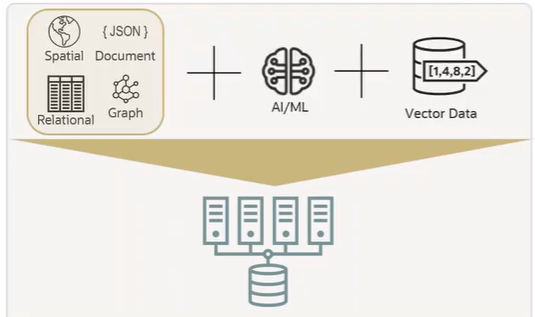
A lot of AI implementations treat the vector database as a separate thing — a specialized system that lives outside your main data infrastructure and requires its own sync processes, security policies, and operational overhead. With RAC, you can store vector embeddings directly alongside your business data, generate them on the fly, and query them using standard SQL.
That’s not a small thing. Every external system you eliminate is a data consistency risk you avoid and an integration you don’t have to maintain. It also means your AI outputs are working from the same source of truth as everything else, which matters when accuracy is non-negotiable.
The indexing layer supports both approaches depending on what you need: traditional B-tree indexes for structured queries and vector indexes for similarity search. They work together rather than competing, which gives you the flexibility to handle hybrid queries — part structured filter, part semantic match — without performance tradeoffs.
Parallelism at Scale
Where this setup really separates itself is in throughput. RAC supports parallelism at two levels, and for AI workloads, both matter.
At the node level, tasks are distributed across the cluster — so a large embedding job or a complex vector retrieval can be spread across multiple machines simultaneously. Within each node, work is further divided across CPU cores. You’re not waiting for one machine to finish; you’re using everything available.
For organizations running on Exadata, the performance gains go further. Smart Scan offloads query processing to the storage layer, Flash Cache keeps frequently accessed data close to compute, and RDMA enables direct memory access between nodes with minimal latency. Cache Fusion — the mechanism that keeps data consistent across nodes — runs faster as a result, which means more responsive queries even under heavy load.
Resilience That Doesn’t Require You to Think About It
Failover in RAC is automatic. When a node becomes unavailable — planned maintenance, hardware issue, doesn’t matter — workloads shift to surviving nodes and users don’t notice. There’s no manual intervention required and no window of downtime to schedule around.
For AI-powered applications specifically, this is significant. If your system is delivering real-time recommendations, surfacing relevant documents, or supporting live customer interactions, intermittent availability isn’t acceptable. The architecture needs to be reliable enough that availability stops being something you actively manage.
Scaling Without Rebuilding
One thing that’s easy to underestimate is how much the scaling model matters as AI workloads grow. RAC supports both directions: adding capacity to existing nodes (more CPU, memory, storage) and adding new nodes to the cluster entirely.
In practice, this means you can start with a configuration that makes sense for current demand and expand without redesigning anything. The shared-everything architecture keeps data consistent across nodes regardless of how many you add, so scaling out doesn’t introduce the consistency headaches you’d get from some distributed approaches.
The Bigger Picture
What’s interesting about this combination isn’t any single capability — it’s what the architecture enables at the system level. When AI workloads, transactional processing, and analytics are all running on the same cluster, sharing the same data, with intelligent isolation keeping them from interfering with each other, you end up with something qualitatively different from the sum of its parts.
Decisions get faster because the data feeding them is current. AI outputs get more reliable because they’re grounded in real enterprise data rather than training-time snapshots. And the infrastructure stays manageable because you’re not maintaining a separate ecosystem of specialized tools.
Organizations that have moved in this direction aren’t just running AI on top of their databases — they’re building data platforms that are genuinely intelligent from the inside out. That’s a different kind of upgrade than most infrastructure conversations are about, and it’s one that tends to compound over time.